Federal:
US Senate: D-51 R-49 Net D + 6
US House: D-220 R-215 Net D + 20-24
Some other sites of note:
Senate Projections:
Pollster R 49-53 D 47-51
Tradesports.com GOP control about 70%
Real Clear Politics D-51 R-49 Net D + 6
House Projections:
Tradesports.com House Dem Pickup Predicts D + 20-25
Tradesports.com GOP control about 15%
Sabato's Crystal Ball
Majority Watch D-241 R-194 Net D + 39
Real Clear Politics D-220 R-215 Net D + 18
Colorado Congressional Delegation:
US Senate: No election. Senior Senator Wayne Allard (R) Junior Senator Ken Salazar (D)
US House: Races listed by competitiveness.
CO-7:
It looked like this race was tightening up in Mid October, but recent pulling shows Democrat Ed Perlmutter pulling away from Republican Rick O'Donnell. Our average of the last three polls (from Real Clear Politics) shows Perlmutter winning 50.6% to 43.6%. We looked at past polls (Polling Report via Colorado Media Matters) and found that the polling average in 2002 was R-40.6 D-39.6, and the final results were 47-47. In 2004 the polling average was R-44.3 D-41.3 and the final result was R-55 D-43. All we can say is that the pollsters don't do very well at guessing the final results (in 04 no one saw Beauprez polling any higher than 46% in the final three polls) but the average of the last three polls has predicted the winner the last two times.
As it looks right now, Perlmutter will be the next Representative from Colorado's 7th CD. Keep it as Leans Dem.
(Originally posted Oct 25th)
The race for Bob Beauprez's open Congress seat is really the best race in Colorado. Real Clear Politics has this race listed as Leans Democrat. We agree. There is just too great a political headwind for Rick O'Donnell (R) to overcome as of right now. However, if you look at the poll numbers you can see that Ed Perlmutter's (D) lead in the polls has decreased from about 10% in September to 5.7% today. The most recent RD Strategies poll has the race tied at 47-47. Word on the political grapevine is that internal Perlmutter polling has the race tied also. This race is shaping up to be another down to the wire repeat of 2002, where Beauprez beat Mike Feely by 121 votes. We are very close to moving this race to Toss Up if we see a few more close polls and the polling average goes down below 5%.
CO-4:
This race has tightened up in the last few days. Our polling average has Paccione (D) head of Musgrave 45.3% to 43.6%. This is not a good place for Musgrave. The Reform party candidate has gotten the endorsement of several newspapers in the district, so it is becoming increasingly likely that he may be a spoiler. We still think that Musgrave is the favorite, but not by much. We have moved this race to Leans GOP and it may become a toss-up or Leans Dem by November 7th. If the Democrats take more than 30 seats in this election, Musgrave is toast.
(Original Post Oct 25th)
Marilyn Musgrave (R) will beat Angie Paccione (D). Every year a handful of Democratic Billionaires throw millions into beating Musgrave. Paccione, with her bankruptcy's intimate details splashed across the airwaves isn't the candidate to do it. Real Clear Politics has this race listed as #28 on their House List. Musgrave's impressive polling numbers have us listing this race as Likely GOP. Note to the Billionaires, find a Salazar or a Ritter and you can win this seat, make sure they don't have bounced checks for pizza listed in a bankruptcy.
CO-5: The newspapers have wasted a great deal of ink on this race. Lamborn (R) has pulled into a double digit lead over his Democratic opponent. This race is over. List it as Safe GOP.
No other changes in the other Colorado House Seats. Degette (D) will win in CO-1. Udall (D) will win in CO-2. Salazar (D) will win in CO-3. Tancredo (R) will win in CO-6.
Colorado:
All incumbents marked with *.
Governor: (Open) Beauprez (R) vs. Ritter (D)
Outlook: Likely Dem.
Downlow: Beauprez, the former congressman from CO-7 hasn't been able to pull within 10 points of Democratic former Denver DA Bill Ritter for what seems like forever. There is too strong a national headwind against Republican's, his campaign now is focused on preventing a complete Democratic sweep in Colorado. Beauprez has, at best, less than a 5% chance of winning. Look at the Real Clear Politics page on the Colorado Gubernatorial race for more data.
Secretary of State: (Open) Mike Coffman (R) vs. Ken Gordon (D)
Outlook: Toss Up.
Downlow:
Mike Coffman served as State Treasurer until he left to serve in Iraq's Al Anbar province during the last election (in Iraq). He is an Officer in the Marines.
Ken Gordon is an Democratic State Senator from Denver. He has excellent credentials and has been a beacon of bipartisanship in the State Senate.
With polling numbers showing this race as tied, we can't predict how the undecideds will break. Gordon has some commercials out on the TV, none are negative. To give you an idea how hard it is for Republicans in Colorado, Coffman's Iraqi war service is being described by some as "cashing in." It is reprehensible, and those individuals will go the way of John Kerry, but not this year.
State Treasurer: Mark Hillman* (R) vs. Cary Kennedy (D)
Outlook: Leans Dem.
Downlow:
(Update 11/7/06)
Recent polling shows Kennedy (D) with a high single digit lead over Hillman. She has TV spots up and has spent loads of money.
(Update 11/04/06)
The tone of this race has changed dramatically in the last few days. Incumbent Mark Hillman is not a veteran of any state-wide elections. Cary Kennedy is a Democratic darling. Her work on Amendment 23 (School Funding Autopilot) has made her more of a lightning rod than we could have predicted. Polling in this race is also stuck at basically a tie with undecideds at about 20%. It all depends on how they break, which may all depend on Beauprez.
Attorney General: Fern O'Brien (D) vs. John Suthers* (R)
Outlook: Leans Republican
Downlow:
This is the one bright race that the GOP has. Fern can't raise money and the incumbent looks set to easily defeat her. We did have it listed as Safe GOP, but no Republican is safe this year.
State Senate:
Outlook: R-15 D-20
Downlow: We just can't see how Matt Knoedler (R) can pick up SD-21 (Lakewood) against veteran campaigner Betty Boyd (D). Even during good GOP years Boyd has outperformed what our models say she should do. This year she has outraised him $150,000 to $63,000. Incumbent Lewis Entz (R) SD-5 (Central Mountains) looks like a loser against Gail Schwartz (D). Entz is a moderate, but when it comes to raw politics, that doesn't matter, Democrats are pouring money into this race. We also see Incumbent Ed Jones SD-11 (R) losing a marginal seat in Colorado Springs. In 2002 he won with a registration advantage of 7% for the GOP. He spent $365,000, matching Mariano almost dollar for dollar. Also, Norma Anderson's old district may be up for grabs. Her hand chosen successor, Kiki Traylor lost a bitter primary to Mike Kopp. Paula Noonan looks to outspend Kopp 2-1 or 3-1 as of right now (70K to well over 200K). As we forecast it now. The GOP will be lucky to come out of this with 15 seats.
State House:
Outlook: R-31 D-34
Downlow: Even in a bad GOP year like 2004, the Colorado GOP still won 5 out of 9 seats that our model predicted as toss ups. This year looks really bad for the GOP, but since they see the writing on the wall we think that they can win half of our 12 predicted toss ups. Basically we are forecasting a wash except that the GOP should pick up HD-57. Our model puts that seat at an 81% probability of going Republican.
Tuesday, November 07, 2006


Saturday, November 04, 2006
2006 Election Projections: (11/04/06)
Federal:
US Senate: D-51 R-49 Net D + 6
US House: D-220 R-215 Net D + 18
Some other sites of note:
Senate Projections:
Tradesports.com GOP control about 70%
Real Clear Politics D-51 R 49 Net D + 6
House Projections:
Tradesports.com GOP control about 30%
Sabato's Crystal Ball
Majority Watch D-241 R-194 Net D + 39
Real Clear Politics D-220 R-215 Net D + 18
Colorado Congressional Delegation:
US Senate: No election. Senior Senator Wayne Allard (R) Junior Senator Ken Salazar (D)
US House: Races listed by competitiveness.
CO-7:
It looked like this race was tightening up in Mid October, but recent pulling shows Democrat Ed Perlmutter pulling away from Republican Rick O'Donnell. Our average of the last three polls (from Real Clear Politics) shows Perlmutter winning 50.6% to 43.6%. We looked at past polls (Polling Report via Colorado Media Matters) and found that the polling average in 2002 was R-40.6 D-39.6, and the final results were 47-47. In 2004 the polling average was R-44.3 D-41.3 and the final result was R-55 D-43. All we can say is that the pollsters don't do very well at guessing the final results (in 04 no one saw Beauprez polling any higher than 46% in the final three polls) but the average of the last three polls has predicted the winner the last two times.
As it looks right now, Perlmutter will be the next Representative from Colorado's 7th CD. Keep it as Leans Dem.
(Originally posted Oct 25th)
The race for Bob Beauprez's open Congress seat is really the best race in Colorado. Real Clear Politics has this race listed as Leans Democrat. We agree. There is just too great a political headwind for Rick O'Donnell (R) to overcome as of right now. However, if you look at the poll numbers you can see that Ed Perlmutter's (D) lead in the polls has decreased from about 10% in September to 5.7% today. The most recent RD Strategies poll has the race tied at 47-47. Word on the political grapevine is that internal Perlmutter polling has the race tied also. This race is shaping up to be another down to the wire repeat of 2002, where Beauprez beat Mike Feely by 121 votes. We are very close to moving this race to Toss Up if we see a few more close polls and the polling average goes down below 5%.
CO-4:
This race has tightened up in the last few days. Our polling average has Paccione (D) head of Musgrave 45.3% to 43.6%. This is not a good place for Musgrave. The Reform party candidate has gotten the endorsement of several newspapers in the district, so it is becoming increasingly likely that he may be a spoiler. We still think that Musgrave is the favorite, but not by much. We have moved this race to Leans GOP and it may become a toss-up or Leans Dem by November 7th. If the Democrats take more than 30 seats in this election, Musgrave is toast.
(Original Post Oct 25th)
Marilyn Musgrave (R) will beat Angie Paccione (D). Every year a handful of Democratic Billionaires throw millions into beating Musgrave. Paccione, with her bankruptcy's intimate details splashed across the airwaves isn't the candidate to do it. Real Clear Politics has this race listed as #28 on their House List. Musgrave's impressive polling numbers have us listing this race as Likely GOP. Note to the Billionaires, find a Salazar or a Ritter and you can win this seat, make sure they don't have bounced checks for pizza listed in a bankruptcy.
CO-5: The newspapers have wasted a great deal of ink on this race. Lamborn (R) has pulled into a double digit lead over his Democratic opponent. This race is over. List it as Safe GOP.
No other changes in the other Colorado House Seats. Degette (D) will win in CO-1. Udall (D) will win in CO-2. Salazar (D) will win in CO-3. Tancredo (R) will win in CO-6.
Colorado:
All incumbents marked with *.
Governor: (Open) Beauprez (R) vs. Ritter (D)
Outlook: Likely Dem.
Downlow: Beauprez, the former congressman from CO-7 hasn't been able to pull within 10 points of Democratic former Denver DA Bill Ritter for what seems like forever. There is too strong a national headwind against Republican's, his campaign now is focused on preventing a complete Democratic sweep in Colorado. Beauprez has, at best, less than a 5% chance of winning. Look at the Real Clear Politics page on the Colorado Gubernatorial race for more data.
Secretary of State: (Open) Mike Coffman (R) vs. Ken Gordon (D)
Outlook: Toss Up.
Downlow:
Mike Coffman served as State Treasurer until he left to serve in Iraq's Al Anbar province during the last election (in Iraq). He is an Officer in the Marines.
Ken Gordon is an Democratic State Senator from Denver. He has excellent credentials and has been a beacon of bipartisanship in the State Senate.
With polling numbers showing this race as tied, we can't predict how the undecideds will break. Gordon has some commercials out on the TV none are negative. To give you an idea how hard it is for Republicans in Colorado Coffman's Iraqi war service is being described by some as "cashing in." It is reprehensible, and those individuals will go the way of John Kerry, but not this year.
State Treasurer: Mark Hillman* (R) vs. Cary Kennedy (D)
Outlook: Toss Up.
Downlow:
The tone of this race has changed dramatically in the last few days. Incumbent Mark Hillman is not a veteran of any state-wide elections. Cary Kennedy is a Democratic darling. Her work on Amendment 23 (School Funding Autopilot) has made her more of a lightning rod than we could have predicted. Polling in this race is also stuck at basically a tie with undecideds at about 20%. It all depends on how they break, which may all depend on Beauprez.
Attorney General: Fern O'Brien (D) vs. John Suthers* (R)
Outlook: Leans Republican
Downlow:
This is the one bright race that the GOP has. Fern can't raise money and the incumbent looks set to easily defeat her. We did have it listed as Safe GOP, but no Republican is safe this year.
State Senate:
Outlook: R-15 D-20
Downlow: We just can't see how Matt Knoedler (R) can pick up SD-21 (Lakewood) against veteran campaigner Betty Boyd (D). Even during good GOP years Boyd has outperformed what our models say she should do. Incumbent Lewis Entz (R) SD-5 (Central Mountains) looks like a loser against Gail Schwartz (D). Entz is a moderate, but when it comes to raw politics, that doesn't matter, Democrats are pouring money into this race. We also see Incumbent Ed Jones SD-11 (R) losing a marginal seat in Colorado Springs.
State House:
Outlook: R-31 D-34
Downlow: Even in a bad GOP year like 2004, the Colorado GOP still won 5 out of 9 seats that our model predicted as toss ups. This year looks really bad for the GOP, but since they see the writing on the wall we think that they can win half of our 12 predicted toss ups. Basically we are forecasting a wash except that the GOP should pick up HD-57. Our model puts that seat at an 81% probability of going Republican.
This page will get reposted everyday with modifications until the election. Updates will be made daily.
US Senate: D-51 R-49 Net D + 6
US House: D-220 R-215 Net D + 18
Some other sites of note:
Senate Projections:
Tradesports.com GOP control about 70%
Real Clear Politics D-51 R 49 Net D + 6
House Projections:
Tradesports.com GOP control about 30%
Sabato's Crystal Ball
Majority Watch D-241 R-194 Net D + 39
Real Clear Politics D-220 R-215 Net D + 18
Colorado Congressional Delegation:
US Senate: No election. Senior Senator Wayne Allard (R) Junior Senator Ken Salazar (D)
US House: Races listed by competitiveness.
CO-7:
It looked like this race was tightening up in Mid October, but recent pulling shows Democrat Ed Perlmutter pulling away from Republican Rick O'Donnell. Our average of the last three polls (from Real Clear Politics) shows Perlmutter winning 50.6% to 43.6%. We looked at past polls (Polling Report via Colorado Media Matters) and found that the polling average in 2002 was R-40.6 D-39.6, and the final results were 47-47. In 2004 the polling average was R-44.3 D-41.3 and the final result was R-55 D-43. All we can say is that the pollsters don't do very well at guessing the final results (in 04 no one saw Beauprez polling any higher than 46% in the final three polls) but the average of the last three polls has predicted the winner the last two times.
As it looks right now, Perlmutter will be the next Representative from Colorado's 7th CD. Keep it as Leans Dem.
(Originally posted Oct 25th)
The race for Bob Beauprez's open Congress seat is really the best race in Colorado. Real Clear Politics has this race listed as Leans Democrat. We agree. There is just too great a political headwind for Rick O'Donnell (R) to overcome as of right now. However, if you look at the poll numbers you can see that Ed Perlmutter's (D) lead in the polls has decreased from about 10% in September to 5.7% today. The most recent RD Strategies poll has the race tied at 47-47. Word on the political grapevine is that internal Perlmutter polling has the race tied also. This race is shaping up to be another down to the wire repeat of 2002, where Beauprez beat Mike Feely by 121 votes. We are very close to moving this race to Toss Up if we see a few more close polls and the polling average goes down below 5%.
CO-4:
This race has tightened up in the last few days. Our polling average has Paccione (D) head of Musgrave 45.3% to 43.6%. This is not a good place for Musgrave. The Reform party candidate has gotten the endorsement of several newspapers in the district, so it is becoming increasingly likely that he may be a spoiler. We still think that Musgrave is the favorite, but not by much. We have moved this race to Leans GOP and it may become a toss-up or Leans Dem by November 7th. If the Democrats take more than 30 seats in this election, Musgrave is toast.
(Original Post Oct 25th)
Marilyn Musgrave (R) will beat Angie Paccione (D). Every year a handful of Democratic Billionaires throw millions into beating Musgrave. Paccione, with her bankruptcy's intimate details splashed across the airwaves isn't the candidate to do it. Real Clear Politics has this race listed as #28 on their House List. Musgrave's impressive polling numbers have us listing this race as Likely GOP. Note to the Billionaires, find a Salazar or a Ritter and you can win this seat, make sure they don't have bounced checks for pizza listed in a bankruptcy.
CO-5: The newspapers have wasted a great deal of ink on this race. Lamborn (R) has pulled into a double digit lead over his Democratic opponent. This race is over. List it as Safe GOP.
No other changes in the other Colorado House Seats. Degette (D) will win in CO-1. Udall (D) will win in CO-2. Salazar (D) will win in CO-3. Tancredo (R) will win in CO-6.
Colorado:
All incumbents marked with *.
Governor: (Open) Beauprez (R) vs. Ritter (D)
Outlook: Likely Dem.
Downlow: Beauprez, the former congressman from CO-7 hasn't been able to pull within 10 points of Democratic former Denver DA Bill Ritter for what seems like forever. There is too strong a national headwind against Republican's, his campaign now is focused on preventing a complete Democratic sweep in Colorado. Beauprez has, at best, less than a 5% chance of winning. Look at the Real Clear Politics page on the Colorado Gubernatorial race for more data.
Secretary of State: (Open) Mike Coffman (R) vs. Ken Gordon (D)
Outlook: Toss Up.
Downlow:
Mike Coffman served as State Treasurer until he left to serve in Iraq's Al Anbar province during the last election (in Iraq). He is an Officer in the Marines.
Ken Gordon is an Democratic State Senator from Denver. He has excellent credentials and has been a beacon of bipartisanship in the State Senate.
With polling numbers showing this race as tied, we can't predict how the undecideds will break. Gordon has some commercials out on the TV none are negative. To give you an idea how hard it is for Republicans in Colorado Coffman's Iraqi war service is being described by some as "cashing in." It is reprehensible, and those individuals will go the way of John Kerry, but not this year.
State Treasurer: Mark Hillman* (R) vs. Cary Kennedy (D)
Outlook: Toss Up.
Downlow:
The tone of this race has changed dramatically in the last few days. Incumbent Mark Hillman is not a veteran of any state-wide elections. Cary Kennedy is a Democratic darling. Her work on Amendment 23 (School Funding Autopilot) has made her more of a lightning rod than we could have predicted. Polling in this race is also stuck at basically a tie with undecideds at about 20%. It all depends on how they break, which may all depend on Beauprez.
Attorney General: Fern O'Brien (D) vs. John Suthers* (R)
Outlook: Leans Republican
Downlow:
This is the one bright race that the GOP has. Fern can't raise money and the incumbent looks set to easily defeat her. We did have it listed as Safe GOP, but no Republican is safe this year.
State Senate:
Outlook: R-15 D-20
Downlow: We just can't see how Matt Knoedler (R) can pick up SD-21 (Lakewood) against veteran campaigner Betty Boyd (D). Even during good GOP years Boyd has outperformed what our models say she should do. Incumbent Lewis Entz (R) SD-5 (Central Mountains) looks like a loser against Gail Schwartz (D). Entz is a moderate, but when it comes to raw politics, that doesn't matter, Democrats are pouring money into this race. We also see Incumbent Ed Jones SD-11 (R) losing a marginal seat in Colorado Springs.
State House:
Outlook: R-31 D-34
Downlow: Even in a bad GOP year like 2004, the Colorado GOP still won 5 out of 9 seats that our model predicted as toss ups. This year looks really bad for the GOP, but since they see the writing on the wall we think that they can win half of our 12 predicted toss ups. Basically we are forecasting a wash except that the GOP should pick up HD-57. Our model puts that seat at an 81% probability of going Republican.
This page will get reposted everyday with modifications until the election. Updates will be made daily.
Thursday, November 02, 2006
2006 Election Projections:
Federal:
US Senate: D-51 R-49 Net D + 6
US House: D-220 R-215 Net D + 18
Some other sites of note:
Senate Projections:
Tradesports.com GOP control about 70%
Real Clear Politics D-51 R 49 Net D + 6
House Projections:
Tradesports.com GOP control about 30%
Sabato's Crystal Ball
Majority Watch D-241 R-194 Net D + 39
Real Clear Politics D-220 R-215 Net D + 18
Colorado:
All incumbents marked with *.
Governor: (Open) Beauprez (R) vs. Ritter (D)
Outlook: Likely Dem.
Downlow: Beauprez, the former congressman from CO-7 hasn't been able to pull within 10 points of Democratic former Denver DA Bill Ritter for what seems like forever. There is too strong a national headwind against Republican's, his campaign now is focused on preventing a complete Democratic sweep in Colorado. Beauprez has, at best, less than a 5% chance of winning. Look at the Real Clear Politics page on the Colorado Gubernatorial race for more data.
Secretary of State: (Open) Mike Coffman (R) vs. Ken Gordon (D)
Outlook: Toss Up.
Downlow:
Mike Coffman served as State Treasurer until he left to serve in Iraq's Al Anbar province during the last election (in Iraq). He is an Officer in the Marines.
Ken Gordon is an Democratic State Senator from Denver. He has excellent credentials and has been a beacon of bipartisanship in the State Senate.
With polling numbers showing this race as tied, we can't predict how the undecideds will break. Gordon has some commercials out on the TV none are negative. To give you an idea how hard it is for Republicans in Colorado Coffman's Iraqi war service is being described by some as "cashing in." It is reprehensible, and those individuals will go the way of John Kerry, but not this year.
State Treasurer: Mark Hillman* (R) vs. Cary Kennedy (D)
Outlook: Toss Up.
Downlow:
The tone of this race has changed dramatically in the last few days. Incumbent Mark Hillman is not a veteran of any state-wide elections. Cary Kennedy is a Democratic darling. Her work on Amendment 23 (School Funding Autopilot) has made her more of a lightning rod than we could have predicted. Polling in this race is also stuck at basically a tie with undecideds at about 20%. It all depends on how they break, which may all depend on Beauprez.
Attorney General: Fern O'Brien (D) vs. John Suthers* (R)
Outlook: Leans Republican
Downlow:
This is the one bright race that the GOP has. Fern can't raise money and the incumbent looks set to easily defeat her. We did have it listed as Safe GOP, but no Republican is safe this year.
State Senate:
Outlook: R-15 D-20
Downlow: We just can't see how Matt Knoedler (R) can pick up SD-21 (Lakewood) against veteran campaigner Betty Boyd (D). Even during good GOP years Boyd has outperformed what our models say she should do. Incumbent Lewis Entz (R) SD-5 (Central Mountains) looks like a loser against Gail Schwartz (D). Entz is a moderate, but when it comes to raw politics, that doesn't matter, Democrats are pouring money into this race. We also see Incumbent Ed Jones (R) losing a marginal seat in Colorado Springs.
State House:
Outlook: R-31 D-34
Downlow: Even in a bad GOP year like 2004, the Colorado GOP still won 5 out of 9 seats that our model predicted as toss ups. This year looks really bad for the GOP, but since they see the writing on the wall we think that they can win half of our 12 predicted toss ups. Basically we are forecasting a wash except that the GOP should pick up HD-57. Our model puts that seat at an 81% probability of going Republican.
This page will get reposted everyday with modifications until the election. Updates will be made daily.
US Senate: D-51 R-49 Net D + 6
US House: D-220 R-215 Net D + 18
Some other sites of note:
Senate Projections:
Tradesports.com GOP control about 70%
Real Clear Politics D-51 R 49 Net D + 6
House Projections:
Tradesports.com GOP control about 30%
Sabato's Crystal Ball
Majority Watch D-241 R-194 Net D + 39
Real Clear Politics D-220 R-215 Net D + 18
Colorado:
All incumbents marked with *.
Governor: (Open) Beauprez (R) vs. Ritter (D)
Outlook: Likely Dem.
Downlow: Beauprez, the former congressman from CO-7 hasn't been able to pull within 10 points of Democratic former Denver DA Bill Ritter for what seems like forever. There is too strong a national headwind against Republican's, his campaign now is focused on preventing a complete Democratic sweep in Colorado. Beauprez has, at best, less than a 5% chance of winning. Look at the Real Clear Politics page on the Colorado Gubernatorial race for more data.
Secretary of State: (Open) Mike Coffman (R) vs. Ken Gordon (D)
Outlook: Toss Up.
Downlow:
Mike Coffman served as State Treasurer until he left to serve in Iraq's Al Anbar province during the last election (in Iraq). He is an Officer in the Marines.
Ken Gordon is an Democratic State Senator from Denver. He has excellent credentials and has been a beacon of bipartisanship in the State Senate.
With polling numbers showing this race as tied, we can't predict how the undecideds will break. Gordon has some commercials out on the TV none are negative. To give you an idea how hard it is for Republicans in Colorado Coffman's Iraqi war service is being described by some as "cashing in." It is reprehensible, and those individuals will go the way of John Kerry, but not this year.
State Treasurer: Mark Hillman* (R) vs. Cary Kennedy (D)
Outlook: Toss Up.
Downlow:
The tone of this race has changed dramatically in the last few days. Incumbent Mark Hillman is not a veteran of any state-wide elections. Cary Kennedy is a Democratic darling. Her work on Amendment 23 (School Funding Autopilot) has made her more of a lightning rod than we could have predicted. Polling in this race is also stuck at basically a tie with undecideds at about 20%. It all depends on how they break, which may all depend on Beauprez.
Attorney General: Fern O'Brien (D) vs. John Suthers* (R)
Outlook: Leans Republican
Downlow:
This is the one bright race that the GOP has. Fern can't raise money and the incumbent looks set to easily defeat her. We did have it listed as Safe GOP, but no Republican is safe this year.
State Senate:
Outlook: R-15 D-20
Downlow: We just can't see how Matt Knoedler (R) can pick up SD-21 (Lakewood) against veteran campaigner Betty Boyd (D). Even during good GOP years Boyd has outperformed what our models say she should do. Incumbent Lewis Entz (R) SD-5 (Central Mountains) looks like a loser against Gail Schwartz (D). Entz is a moderate, but when it comes to raw politics, that doesn't matter, Democrats are pouring money into this race. We also see Incumbent Ed Jones (R) losing a marginal seat in Colorado Springs.
State House:
Outlook: R-31 D-34
Downlow: Even in a bad GOP year like 2004, the Colorado GOP still won 5 out of 9 seats that our model predicted as toss ups. This year looks really bad for the GOP, but since they see the writing on the wall we think that they can win half of our 12 predicted toss ups. Basically we are forecasting a wash except that the GOP should pick up HD-57. Our model puts that seat at an 81% probability of going Republican.
This page will get reposted everyday with modifications until the election. Updates will be made daily.
Tuesday, October 31, 2006
Final touches going into Colorado's Election Projection 2006.
We are still wading through the data from the last few elections. Some districts are defying the current model so we are trying to patch those problems up.
We are going to do something that no one else is doing...calling every single election for the state legislature. Others may take the easy route, "Democratic control" or "GOP control," not us. We will predict every single seat.
But first we've gotta finish this pesky model.
We are going to do something that no one else is doing...calling every single election for the state legislature. Others may take the easy route, "Democratic control" or "GOP control," not us. We will predict every single seat.
But first we've gotta finish this pesky model.
Monday, October 30, 2006
New model coming soon, preliminary findings support Democratic gains.
We are working on our second version of our econometric model for the Colorado State Legislature. After the data from 2000 was added we discovered that the model needed some major retooling.
Here are our basic findings as of right now.
Democrats are more "efficient" at getting votes than Republicans in Colorado. All things being equal, if you have a district that is divided evenly between Republicans, Democrats and unaffiliated voters, the Democrat will win 3 out of 4 times. After tonight we will have different regression equations for the last three elections to show how the Democrats have become more efficient.
2004 was a "wave" election for the Democrats. There is still a lot of arguing going on over here, but something changed in Colorado in 2004. The Democrats picked up 7 State House seats (the equivalent of over 50 US House seats). Some of us think that Amendment 27 (campaign finance) is the key, others think that the GOP is more divided than it was before. Nevertheless, by this time tomorrow we should have a new model out, and new predictions for the State House and State Senate.
The Rocky Mountain News has a great story out today on the GOPs slide from power in the Legislature. Check it out here. The one flaw we saw in it, no talk of the power of Amendment 27.
Here are our basic findings as of right now.
Democrats are more "efficient" at getting votes than Republicans in Colorado. All things being equal, if you have a district that is divided evenly between Republicans, Democrats and unaffiliated voters, the Democrat will win 3 out of 4 times. After tonight we will have different regression equations for the last three elections to show how the Democrats have become more efficient.
2004 was a "wave" election for the Democrats. There is still a lot of arguing going on over here, but something changed in Colorado in 2004. The Democrats picked up 7 State House seats (the equivalent of over 50 US House seats). Some of us think that Amendment 27 (campaign finance) is the key, others think that the GOP is more divided than it was before. Nevertheless, by this time tomorrow we should have a new model out, and new predictions for the State House and State Senate.
The Rocky Mountain News has a great story out today on the GOPs slide from power in the Legislature. Check it out here. The one flaw we saw in it, no talk of the power of Amendment 27.
Thursday, October 26, 2006
State House Update 10/26/2006
The Downlow: The magic number for control of the State House is 33. With 65 total seats you need 33 for control. Every seat is up for election every two years, no member can serve more than four two year terms, which makes it easy to break the members down into Freshmen, Sophomores, Juniors and Seniors. The State House is currently made up of 30 Republicans and 35 Democrats. Democrats took control for the first time in 30 years in 2004.
Below is a list of the seats that are up for election this year. They are arranged by likelihood of changing control. None of these races have links, as we add individual District pages to MHD we will update this page. Our current econometric model is woefully inadequate, we will have our 1.2 version out this weekend, until then forgive us for the huge number of toss-ups, we are working on it. Look for an update Monday.
33 needed for control: Delphi Forecasts GOP 28 Dem 37
Incumbent = *
Tossups: 12
HD-17: Mark Cloer* (R) vs. Christine Varney (D)
HD-23: Ramey Johnson (R) vs. Gwen Green* (D)
HD-26: Andy Kerr* (D) vs. Glenn Rhoades (R)
HD-27: Bill Crane* (R) vs. Sara Gagliardi (D)
HD-29: Debbie Benefield* (D) vs. Affie Ellis (R)
HD-33: Bill Berens* (R) vs. Dianne Primavera (D)
HD-50: Dave Owen (R) vs. James Reisberg* (D)
HD-52: John Kefalas (D) vs. Bob McCluskey* (R)
HD-53: Randy Fischer (D) vs. Anne Yeldell (R)
HD-55: Bernie Buescher* (D) vs. Bob Caskey (R)
HD-56: Ken Chlouber (R) vs. Dan Gibbs (D)
HD-59: Joe Colgan (D) vs Ellen Roberts (R)
Leans/Likely Democrat: 8
HD-11: Jack Pommer* (D) vs. Catherine Jarrett (R)
HD-18: Michael Merrifield* (D) vs. Kyle Fisk (R)
HD-30: Darrin Dutcher (R) vs. Mary Hodge* (D)
HD-31: Rex Pierce (R) vs. Judy Solano* (D)
HD-36: Brian Boney (R) vs. Morgan Carroll* (D)
HD-41: Clyde Robinson (R) vs. Nancy Todd* (D)
HD-47: Liane "Buffie" McFadyen* (D) vs. Jeff Shaw (R)
HD-64: John Albright (R) vs. Wesley McKinley* (D)
Leans/Likely Republican: 15
HD-19: Kenneth Barela (D) vs. Marsha Looper (R)
HD-22: Jayson Haberkorn (D) vs. Kenneth Summers (R)
HD-25: Rob Witwer* (R) vs. Michael Daniels (D)
HD-28: James Kerr* (R) vs. Thomas Dittemore (D)
HD-37: Angela Engel (D) vs. Spencer Swalm (R)
HD-38: Matt Dunn (R) vs. Joe Rice (D)
HD-39: David Balmer* (R) vs. Mollie Cullom (D)
HD-40: Debbie Stafford* (R) vs. Matt Bryant (D)
HD-48: Michael Dugan (D) vs. Gleen Vaad (R)
HD-49: Kevin Lundberg* (R) vs Susan Radford (D)
HD-51: Don Marostica (R) vs. Jodi Radke (D)
HD-54: Richard Alward (D) vs. Steven King (R)
HD-57: Andrew Gold (D) vs. Al White* (R)
HD-58: Brian Ahern (D) vs. Ray Rose* (R)
HD-60: Curtis Imrie (D) vs. Tom Massey* (R)
Safe Democrat: 20
HD-1: Jeanne Labuda (D) vs. Aimee Rathburn (R)
HD-2: Mike Cerbo* (D) unopposed
HD-3: Anne McGihon* (D) unopposed
HD-4: Jerry Frangas* (D) vs. Rick Nevin (R)
HD-5: Joel Judd* (D) unopposed
HD-6: Andrew Romanoff* (D) vs. Jeffrey Hecht (R)
HD-7: Terrance Carroll* (D) unopposed
HD-8: Rosemary Marshall* (D) unopposed
HD-9: Alice Borodkin* (D) vs. Jerry Greenheck (R)
HD-10: Alice Madden* (D) unopposed
HD-12: Paul Weissmann* (D) unopposed
HD-13: Claire Levy (D) unopposed
HD-24: Cheri Jahn* (D) unopposed
HD-32: Edward Casso (D) vs. Tracey Snyder (R)
HD-34: John Soper (D) unopposed
HD-35: Ruben Pacheco (R) vs. Cherylin Peniston (D)
HD-42: Michael Garcia (D) unopposed
HD-46: Dorothy Butcher (D) vs. Susan Pelto (R)
HD-61: Kathleen Curry (D) unopposed
HD-62: Rafael Gallegos* (D) vs. John Sandoval (R)
Safe Republican: 10
HD-14: Kent Lambert (R) vs. Karen Teja (D)
HD-15: Bill Cadman (R) vs. Allison Hunter (D)
HD-16: Larry Liston* (R) unopposed
HD-20: Amy Stephens (R) vs. Janet Hejtmaneck (D)
HD-21: Bob Gardner (R) vs. Anna Lord (D)
HD-43: Allen Dreher (D) vs. Frank McNulty (R)
HD-44: Lois Huff (D) vs. Mike May* (R)
HD-45: Linda Constantine (D) vs. Victor Mitchell (R)
HD-63: Pauline Artery (D) vs. Cory Gardner* (R)
HD-65: Jerry Sonnenberg (R) unopposed
Below is a list of the seats that are up for election this year. They are arranged by likelihood of changing control. None of these races have links, as we add individual District pages to MHD we will update this page. Our current econometric model is woefully inadequate, we will have our 1.2 version out this weekend, until then forgive us for the huge number of toss-ups, we are working on it. Look for an update Monday.
33 needed for control: Delphi Forecasts GOP 28 Dem 37
Incumbent = *
Tossups: 12
HD-17: Mark Cloer* (R) vs. Christine Varney (D)
HD-23: Ramey Johnson (R) vs. Gwen Green* (D)
HD-26: Andy Kerr* (D) vs. Glenn Rhoades (R)
HD-27: Bill Crane* (R) vs. Sara Gagliardi (D)
HD-29: Debbie Benefield* (D) vs. Affie Ellis (R)
HD-33: Bill Berens* (R) vs. Dianne Primavera (D)
HD-50: Dave Owen (R) vs. James Reisberg* (D)
HD-52: John Kefalas (D) vs. Bob McCluskey* (R)
HD-53: Randy Fischer (D) vs. Anne Yeldell (R)
HD-55: Bernie Buescher* (D) vs. Bob Caskey (R)
HD-56: Ken Chlouber (R) vs. Dan Gibbs (D)
HD-59: Joe Colgan (D) vs Ellen Roberts (R)
Leans/Likely Democrat: 8
HD-11: Jack Pommer* (D) vs. Catherine Jarrett (R)
HD-18: Michael Merrifield* (D) vs. Kyle Fisk (R)
HD-30: Darrin Dutcher (R) vs. Mary Hodge* (D)
HD-31: Rex Pierce (R) vs. Judy Solano* (D)
HD-36: Brian Boney (R) vs. Morgan Carroll* (D)
HD-41: Clyde Robinson (R) vs. Nancy Todd* (D)
HD-47: Liane "Buffie" McFadyen* (D) vs. Jeff Shaw (R)
HD-64: John Albright (R) vs. Wesley McKinley* (D)
Leans/Likely Republican: 15
HD-19: Kenneth Barela (D) vs. Marsha Looper (R)
HD-22: Jayson Haberkorn (D) vs. Kenneth Summers (R)
HD-25: Rob Witwer* (R) vs. Michael Daniels (D)
HD-28: James Kerr* (R) vs. Thomas Dittemore (D)
HD-37: Angela Engel (D) vs. Spencer Swalm (R)
HD-38: Matt Dunn (R) vs. Joe Rice (D)
HD-39: David Balmer* (R) vs. Mollie Cullom (D)
HD-40: Debbie Stafford* (R) vs. Matt Bryant (D)
HD-48: Michael Dugan (D) vs. Gleen Vaad (R)
HD-49: Kevin Lundberg* (R) vs Susan Radford (D)
HD-51: Don Marostica (R) vs. Jodi Radke (D)
HD-54: Richard Alward (D) vs. Steven King (R)
HD-57: Andrew Gold (D) vs. Al White* (R)
HD-58: Brian Ahern (D) vs. Ray Rose* (R)
HD-60: Curtis Imrie (D) vs. Tom Massey* (R)
Safe Democrat: 20
HD-1: Jeanne Labuda (D) vs. Aimee Rathburn (R)
HD-2: Mike Cerbo* (D) unopposed
HD-3: Anne McGihon* (D) unopposed
HD-4: Jerry Frangas* (D) vs. Rick Nevin (R)
HD-5: Joel Judd* (D) unopposed
HD-6: Andrew Romanoff* (D) vs. Jeffrey Hecht (R)
HD-7: Terrance Carroll* (D) unopposed
HD-8: Rosemary Marshall* (D) unopposed
HD-9: Alice Borodkin* (D) vs. Jerry Greenheck (R)
HD-10: Alice Madden* (D) unopposed
HD-12: Paul Weissmann* (D) unopposed
HD-13: Claire Levy (D) unopposed
HD-24: Cheri Jahn* (D) unopposed
HD-32: Edward Casso (D) vs. Tracey Snyder (R)
HD-34: John Soper (D) unopposed
HD-35: Ruben Pacheco (R) vs. Cherylin Peniston (D)
HD-42: Michael Garcia (D) unopposed
HD-46: Dorothy Butcher (D) vs. Susan Pelto (R)
HD-61: Kathleen Curry (D) unopposed
HD-62: Rafael Gallegos* (D) vs. John Sandoval (R)
Safe Republican: 10
HD-14: Kent Lambert (R) vs. Karen Teja (D)
HD-15: Bill Cadman (R) vs. Allison Hunter (D)
HD-16: Larry Liston* (R) unopposed
HD-20: Amy Stephens (R) vs. Janet Hejtmaneck (D)
HD-21: Bob Gardner (R) vs. Anna Lord (D)
HD-43: Allen Dreher (D) vs. Frank McNulty (R)
HD-44: Lois Huff (D) vs. Mike May* (R)
HD-45: Linda Constantine (D) vs. Victor Mitchell (R)
HD-63: Pauline Artery (D) vs. Cory Gardner* (R)
HD-65: Jerry Sonnenberg (R) unopposed
Wednesday, October 25, 2006
Midweek Race Update.
With only a fortnight to go before the election here is the skinny on Colorado's biggest political races.
Governor: Real Clear Politics has this race listed as Leans Democrat. We think that Beauprez (R) has at best a 5-10% chance of winning this race. The RCP poll average shows Ritter (D) with a 10.6% lead in the polls. We list this race as Likely Dem.
Other Statewide: NO Changes. A few polls are out, if we see Beauprez running over 15 points behind Ritter we may have to reconsider some of these races.
CO-7: The race for Bob Beauprez's open Congress seat is really the best race in Colorado. Real Clear Politics has this race listed as Leans Democrat. We agree. There is just too great a political headwind for Rick O'Donnell (R) to overcome as of right now. However, if you look at the poll numbers you can see that Ed Perlmutter's (D) lead in the polls has decreased from about 10% in September to 5.7% today. The most recent RD Strategies poll has the race tied at 47-47. Word on the political grapevine is that internal Perlmutter polling has the race tied also. This race is shaping up to be another down to the wire repeat of 2002, where Beauprez beat Mike Feely by 121 votes. We are very close to moving this race to Toss Up if we see a few more close polls and the polling average goes down below 5%.
CO-4: Marilyn Musgrave (R) will beat Angie Paccione (D). Every year a handful of Democratic Billionqires throw millions into beating Musgrave. Paccione, with her bankruptcy's intimate details splashed across the airwaves isn't the candidate to do it. Real Clear Politics has this race listed as #28 on their House List. Musgrave's impressive polling numbers have us listing this race as Likely GOP. Note to the Billionaires, find a Salazar or a Ritter and you can win this seat, make sure they don't have bounced checks for pizza listed in a bankruptcy.
CO-5: The newspapers have wasted a great deal of ink on this race. Lamborn (R) has pulled into a double digit lead over his Democratic opponent. This race is over. List it as Safe GOP.
No other changes in the other Colorado House Seats. Degette (D) will win in CO-1. Udall (D) will win in CO-2. Salazar (D) will win in CO-3. Tancredo (R) will win in CO-6.
We will add links to all state-wide races over the next week.
Tomorrow we will add an update to our State House page modeled after our State Senate page.
We won't be doing any predictions on the state-wide Referenda.
Governor: Real Clear Politics has this race listed as Leans Democrat. We think that Beauprez (R) has at best a 5-10% chance of winning this race. The RCP poll average shows Ritter (D) with a 10.6% lead in the polls. We list this race as Likely Dem.
Other Statewide: NO Changes. A few polls are out, if we see Beauprez running over 15 points behind Ritter we may have to reconsider some of these races.
CO-7: The race for Bob Beauprez's open Congress seat is really the best race in Colorado. Real Clear Politics has this race listed as Leans Democrat. We agree. There is just too great a political headwind for Rick O'Donnell (R) to overcome as of right now. However, if you look at the poll numbers you can see that Ed Perlmutter's (D) lead in the polls has decreased from about 10% in September to 5.7% today. The most recent RD Strategies poll has the race tied at 47-47. Word on the political grapevine is that internal Perlmutter polling has the race tied also. This race is shaping up to be another down to the wire repeat of 2002, where Beauprez beat Mike Feely by 121 votes. We are very close to moving this race to Toss Up if we see a few more close polls and the polling average goes down below 5%.
CO-4: Marilyn Musgrave (R) will beat Angie Paccione (D). Every year a handful of Democratic Billionqires throw millions into beating Musgrave. Paccione, with her bankruptcy's intimate details splashed across the airwaves isn't the candidate to do it. Real Clear Politics has this race listed as #28 on their House List. Musgrave's impressive polling numbers have us listing this race as Likely GOP. Note to the Billionaires, find a Salazar or a Ritter and you can win this seat, make sure they don't have bounced checks for pizza listed in a bankruptcy.
CO-5: The newspapers have wasted a great deal of ink on this race. Lamborn (R) has pulled into a double digit lead over his Democratic opponent. This race is over. List it as Safe GOP.
No other changes in the other Colorado House Seats. Degette (D) will win in CO-1. Udall (D) will win in CO-2. Salazar (D) will win in CO-3. Tancredo (R) will win in CO-6.
We will add links to all state-wide races over the next week.
Tomorrow we will add an update to our State House page modeled after our State Senate page.
We won't be doing any predictions on the state-wide Referenda.
Wednesday, October 18, 2006
State Senate Update 10/18/06
The Downlow: The magic number for control of the State Senate is 18. With 35 total seats you need 18 for control. This year 18 seats are up for election, one is only for a two year term due to a resignation (read below). Seven Republican held seats are not up for election as are ten Democratic seats.
Below is a list of the seats that are up for election this year. They are arranged by likelihood of changing control. Some races have links, our default for each race is the Rocky Mountain News, as we add individual District pages to MHD we will update this page:
18 needed for control: Delphi Forecasts GOP 16 Dem 19
Incumbent = *
Tossups:
SD-5:Lewis Entz* (R) vs. Gail Schwartz (D)
SD-11:Ed Jones* (R) vs. John Morse (D)
SD-21:Berry Boyd* (D) vs. Matt Knoedler (R)
Leans/Likely Democrat:
SD-6:Jim Isgar* (D) vs. Ronald Tate (R)
SD-16:Joan Fitz-Gerald* (D) vs. Marty Neilson (R)
SD-24:Luis Alvarez (R) vs. Lois Tochtrop* (D)
SD-20:Maryanne "Moe" Keller* (D) vs. Dick Sargent (R)
Leans/Likely Republican:
SD-13:Solomon Little Owl (D) vs. Scott Renfroe (R)
SD-07:Dana Barker (D) vs. Joshua Penry (R)
SD-15:Steve Johnson* (R) vs. Jennifer Miller (D)
SD-22:Mike Kopp (R) vs. Paula Noonan (D)
Safe Democrat:
SD-3:Abel Tapia* (D) unopposed
SD-32:Dave Lewis (R) vs. Chris Romer (D)
SD-34:Paula Sandoval (D) unopposed
Safe Republican:
SD-1:James Bowen (D) vs. Greg Brophy* (R)
SD-2:Michael Griego (D) vs. Kenneth Kester* (R)
SD-9:Keely Marrs (D) vs. David Schultheis (R)
SD-30:Ted Harvey (R) vs. Shelly Tokerud (D)
Colorado State Senate Homepage
Below is a list of the seats that are up for election this year. They are arranged by likelihood of changing control. Some races have links, our default for each race is the Rocky Mountain News, as we add individual District pages to MHD we will update this page:
18 needed for control: Delphi Forecasts GOP 16 Dem 19
Incumbent = *
Tossups:
SD-5:Lewis Entz* (R) vs. Gail Schwartz (D)
SD-11:Ed Jones* (R) vs. John Morse (D)
SD-21:Berry Boyd* (D) vs. Matt Knoedler (R)
Leans/Likely Democrat:
SD-6:Jim Isgar* (D) vs. Ronald Tate (R)
SD-16:Joan Fitz-Gerald* (D) vs. Marty Neilson (R)
SD-24:Luis Alvarez (R) vs. Lois Tochtrop* (D)
SD-20:Maryanne "Moe" Keller* (D) vs. Dick Sargent (R)
Leans/Likely Republican:
SD-13:Solomon Little Owl (D) vs. Scott Renfroe (R)
SD-07:Dana Barker (D) vs. Joshua Penry (R)
SD-15:Steve Johnson* (R) vs. Jennifer Miller (D)
SD-22:Mike Kopp (R) vs. Paula Noonan (D)
Safe Democrat:
SD-3:Abel Tapia* (D) unopposed
SD-32:Dave Lewis (R) vs. Chris Romer (D)
SD-34:Paula Sandoval (D) unopposed
Safe Republican:
SD-1:James Bowen (D) vs. Greg Brophy* (R)
SD-2:Michael Griego (D) vs. Kenneth Kester* (R)
SD-9:Keely Marrs (D) vs. David Schultheis (R)
SD-30:Ted Harvey (R) vs. Shelly Tokerud (D)
Colorado State Senate Homepage
Tuesday, October 17, 2006
New National Forecast!
It is our opinion that if the election was held today the Democratic Party would win both the House and the Senate.
Sabato's Crystal Ball does a good job of summing up the House and Senate races.
The probability numbers are from tradesports.com, so they need not match our projections.
As it stands now we forecast the Democrats picking up 20 House seats and six Senate seats.
Sabato's Crystal Ball does a good job of summing up the House and Senate races.
The probability numbers are from tradesports.com, so they need not match our projections.
As it stands now we forecast the Democrats picking up 20 House seats and six Senate seats.
New State Senate Update Tomorrow!
Tomorrow we will publish our new State Senate updates. Look for it in the morning.
Wednesday, October 04, 2006
Prediction updates!
Our top of the ticket page has been updated with a short summary of the race as it stands now (Likely Democrat) and a link to Real Clear Politics excellent page on the Gubernatorial Race.
Here is a quick look at the race:
RCP Poll Average: Ritter (D) winning by 16.7%
Tradesports gives Ritter a 91% probability of winning.
Lower down on the ticket:
Secretary of State:
Mike Coffman (R) vs. Ken Gordon (D)
Mike Coffman served as State Treasurer until he left to serve in Iraq's Al Anbar province during the last election (in Iraq). He is an Officer in the Marines.
Ken Gordon is an Democratic State Senator from Denver. He has excellent credentials and has been a beacon of bipartisanship in the State Senate.
We haven't seen any polls, however we have to say that this race currently leans GOP based upon Coffman's service in Iraq. Unless the Beauprez campaign completely implodes and loses by more than 20%, Coffman should pull out a win. Mark this race as leans GOP.
State Treasurer:
Mark Hillman* (R) vs. Cary Kennedy (D)
Mark Hillman faces what could be the toughest statewide race. He is an incumbent but Kennedy is outfundraising him. No real buzz surrounding this race. Toss Up.
Attorney General:
Fern O'Brien (D) vs. John Suthers* (R)
This is the one bright race that the GOP has. Fern can't raise money and the incumbent looks set to easily defeat her. Safe GOP.
Related News Stories:
CO: Republican Candidates Emphasize Geography -Rocky Mountain News
Here is a quick look at the race:
RCP Poll Average: Ritter (D) winning by 16.7%
Tradesports gives Ritter a 91% probability of winning.
Lower down on the ticket:
Secretary of State:
Mike Coffman (R) vs. Ken Gordon (D)
Mike Coffman served as State Treasurer until he left to serve in Iraq's Al Anbar province during the last election (in Iraq). He is an Officer in the Marines.
Ken Gordon is an Democratic State Senator from Denver. He has excellent credentials and has been a beacon of bipartisanship in the State Senate.
We haven't seen any polls, however we have to say that this race currently leans GOP based upon Coffman's service in Iraq. Unless the Beauprez campaign completely implodes and loses by more than 20%, Coffman should pull out a win. Mark this race as leans GOP.
State Treasurer:
Mark Hillman* (R) vs. Cary Kennedy (D)
Mark Hillman faces what could be the toughest statewide race. He is an incumbent but Kennedy is outfundraising him. No real buzz surrounding this race. Toss Up.
Attorney General:
Fern O'Brien (D) vs. John Suthers* (R)
This is the one bright race that the GOP has. Fern can't raise money and the incumbent looks set to easily defeat her. Safe GOP.
Related News Stories:
CO: Republican Candidates Emphasize Geography -Rocky Mountain News
Monday, October 02, 2006
Updated Predictions.
Tomorrow all of our state-wide predictions will be modified, along with the US Congress races. Our economist will have his model done by the end of the week, which will give us a probability of victory for every single state legislative race.
Additionally another contributor will be breaking some news over at polstate.com. It will be cross posted here.
Additionally we may finally have our maps up this weekend.
Additionally another contributor will be breaking some news over at polstate.com. It will be cross posted here.
Additionally we may finally have our maps up this weekend.
Wednesday, August 23, 2006
New SUSA Poll Shows Tie In 7th CD.
A new SUSA poll shows a tie between Democrat Ed Perlmutter and Republican Rick O'Donnell in Colorado's 7th CD.
A link to the poll is available here.
This is important because earlier signs were pointing towards this district leaning much more Democratic than it did when Congressman (and Gubernatorial Candidate) Bob Beauprez (R) won it in 2002 and 2004.
Here is a quick abstract of the poll:
O'Donnell (R) 45% Perlmutter (D) 45% Undecided 6%
Interesting notes include the fact that a Green Party Candidate and a Libertarian both are polling at 2%.
This poll will not cause us to move this race from Leans Dem. The reason is because the survey sample was 44% Republican. We need to see more polls before we will move this race.
A link to the poll is available here.
This is important because earlier signs were pointing towards this district leaning much more Democratic than it did when Congressman (and Gubernatorial Candidate) Bob Beauprez (R) won it in 2002 and 2004.
Here is a quick abstract of the poll:
O'Donnell (R) 45% Perlmutter (D) 45% Undecided 6%
Interesting notes include the fact that a Green Party Candidate and a Libertarian both are polling at 2%.
This poll will not cause us to move this race from Leans Dem. The reason is because the survey sample was 44% Republican. We need to see more polls before we will move this race.
Monday, August 21, 2006
Is GOP Candidate O'Donnell In Trouble in CD-07?
The market prices over at tradesports.com has the Republican Candidate for Colorado's 7th Congressional District rated as a severe underdog.
The market opened in April with a 50-50 price structure. Almost immediately the market went to 55-45 in favor of the Democratic candidate (and this was before we even knew who would win the primary).
Ed Perlmutter (D) a former State Senator won the Democratic primary and is now considered the favorite to win the district. GOP candidate Rick O'Donnell avoided a primary. No polls are available as of right now. A chart of the price for a futures contract for a Perlmutter victory is available over at polstate.com.
Current odds on the GOP holding this seat are 2/11 or about 18% according to the Tradesports.com market.
This has caused us to move this race from a Toss-Up to Lean Democrat.
Here are some campaign finance numbers from Larry Sabato's Crystal Ball:
The market opened in April with a 50-50 price structure. Almost immediately the market went to 55-45 in favor of the Democratic candidate (and this was before we even knew who would win the primary).
Ed Perlmutter (D) a former State Senator won the Democratic primary and is now considered the favorite to win the district. GOP candidate Rick O'Donnell avoided a primary. No polls are available as of right now. A chart of the price for a futures contract for a Perlmutter victory is available over at polstate.com.
Current odds on the GOP holding this seat are 2/11 or about 18% according to the Tradesports.com market.
This has caused us to move this race from a Toss-Up to Lean Democrat.
Here are some campaign finance numbers from Larry Sabato's Crystal Ball:
Ed Perlmutter - Democrat - Second Quarter Raised: $300,110.58 | Cash on Hand: $515,009.05
Rick O'Donnell - Republican - Second Quarter Raised: $307,895.91 | Cash on Hand: $855,970.43
Sunday, August 20, 2006
State Senate Homepage updated.
The Colorado State Senate Homepage has been updated. Its now more detailed and it keeps getting better. As of now we only see eight seats that are competitive, that list could widen but will probably dwindle down to one or two.
During the next week we will be focusing on the State Senate, we will try and put up details for every race such as registration numbers, campaign donations, links to candidate websites etc...
Maybe, just maybe we will get a map up.
During the next week we will be focusing on the State Senate, we will try and put up details for every race such as registration numbers, campaign donations, links to candidate websites etc...
Maybe, just maybe we will get a map up.
Thursday, August 17, 2006
Updated odds for control of Congress after 2006. (8/18/2006)
Here are the updated odds for the GOP to keep control of the US House and Senate this fall as taken from tradesports.com.
US House 44.8%.
Democrats now favored to take control of US House.
US Senate 81.0%.
The GOP is favored to keep control of the US Senate.
A link to the tradesports.com GOP06 page is available here.
US House 44.8%.
Democrats now favored to take control of US House.
US Senate 81.0%.
The GOP is favored to keep control of the US Senate.
A link to the tradesports.com GOP06 page is available here.
Rising Tide: Can the Democrats Take the Majority of Colorado's House Delegation.
It is hard to believe but the GOP enjoyed a 5-2 majority in Colorado's US House Delegation as recently as two years ago. The Democratic Party is definitely waxing here in the Centennial State as they move to take a 4-3 lead in the delegation this year.
Here is how it breaks down.
HD-1 (City and County of Denver) Safe Dem
HD-2 (Boulder and Central Mountains) Safe Dem
HD-3 (Western Slope) Crystal Ball says Leans Dem; Cook Report says Likely Dem PVI R+6
HD-4 (Eastern Plains) Crystal Ball says Likely GOP; Cook Report says Likely GOP PVI R+9
HD-5 (Colorado Springs) Safe GOP (OPEN)
HD-6 (Southern Denver Suburbs) Safe GOP
HD-7 (Western and Eastern Suburbs) Toss Up according to both Cook and the Ball PVI D+2 (OPEN)
Here is how it breaks down.
HD-1 (City and County of Denver) Safe Dem
HD-2 (Boulder and Central Mountains) Safe Dem
HD-3 (Western Slope) Crystal Ball says Leans Dem; Cook Report says Likely Dem PVI R+6
HD-4 (Eastern Plains) Crystal Ball says Likely GOP; Cook Report says Likely GOP PVI R+9
HD-5 (Colorado Springs) Safe GOP (OPEN)
HD-6 (Southern Denver Suburbs) Safe GOP
HD-7 (Western and Eastern Suburbs) Toss Up according to both Cook and the Ball PVI D+2 (OPEN)
Tuesday, August 15, 2006
Colorado Governor 2006 (updated 08/15/2006)
Our most recent update on the Gubernatorial Race is available here.
Monday, August 14, 2006
Election Overview
Here is a quick snapshot of Colorado's political landscape:
At the top of the ticket is a Governor's race that is currently leaning Democratic. It seems that after eight years of Republican leadership the state may be leaning towards Bill Ritter and change.
There will be an update on the Governor's race up tomorrow, with appropriate links. Currently Larry Sabato over at the Crystal Ball has the race listed as Leans Dem and The Cook Political Report has the race as a TOSS UP.
The other state-wide races for Treasurer, Sec. of State etc... should all go Republican, I haven't seen any polling or fundraising numbers that make it look like the Dems are competitive on any of these seats.
The legislature is far more difficult to predict. Even though a swarm of Conservative Republicans won in Tuesday's primary it doesn't look like any of those seats are likely Democratic pickups. Ramey Johnson (R) managed to win her primary for House District 23...a moderate Republican that could easily beat the underwhelming Gwen Green. Even though Green beat her in 2004 by a few dozen votes, it seems that the GOP circular firing squad may sit this one out, and Johnson gets to run as that most endangered of species...the moderate Republican.
As it stands now it appears that the GOP has about a 50% chance of winning the State House.
The State Senate is a far harder pickup for the GOP. Look for the Dems to hold the Senate and maybe even pick up a seat.
I'll have new legislative projections up over the course of the next fortnight.
National projections will follow after that.
At the top of the ticket is a Governor's race that is currently leaning Democratic. It seems that after eight years of Republican leadership the state may be leaning towards Bill Ritter and change.
There will be an update on the Governor's race up tomorrow, with appropriate links. Currently Larry Sabato over at the Crystal Ball has the race listed as Leans Dem and The Cook Political Report has the race as a TOSS UP.
The other state-wide races for Treasurer, Sec. of State etc... should all go Republican, I haven't seen any polling or fundraising numbers that make it look like the Dems are competitive on any of these seats.
The legislature is far more difficult to predict. Even though a swarm of Conservative Republicans won in Tuesday's primary it doesn't look like any of those seats are likely Democratic pickups. Ramey Johnson (R) managed to win her primary for House District 23...a moderate Republican that could easily beat the underwhelming Gwen Green. Even though Green beat her in 2004 by a few dozen votes, it seems that the GOP circular firing squad may sit this one out, and Johnson gets to run as that most endangered of species...the moderate Republican.
As it stands now it appears that the GOP has about a 50% chance of winning the State House.
The State Senate is a far harder pickup for the GOP. Look for the Dems to hold the Senate and maybe even pick up a seat.
I'll have new legislative projections up over the course of the next fortnight.
National projections will follow after that.
Wednesday, June 14, 2006
New June 2006 US Senate and House Projections.
I've gotten a lot of info to chew on but here is the gist of it.
As it stands now:
The Democrats are projected to pick up 1 seat in the US Senate (most probably Penn.)
The projected makeup of the US Senate in 2007-8. 54 Rep. - 46 Dem.
The Democrats are projected to pick up 13 seats in the US House (the numbers are too numerous to put up here).
The projected makeup of the US House in 2007-8. 219 Rep. - 216 Dem.
The Dems will be two seats short of a majority. Don't read this as a GOP victory, it is basically a toss-up for control of the House. Momentum is against the GOP.
As it stands now:
The Democrats are projected to pick up 1 seat in the US Senate (most probably Penn.)
The projected makeup of the US Senate in 2007-8. 54 Rep. - 46 Dem.
The Democrats are projected to pick up 13 seats in the US House (the numbers are too numerous to put up here).
The projected makeup of the US House in 2007-8. 219 Rep. - 216 Dem.
The Dems will be two seats short of a majority. Don't read this as a GOP victory, it is basically a toss-up for control of the House. Momentum is against the GOP.
Tuesday, June 13, 2006
US Senate and House Projections coming tonight.
I've got the projections, I just have to put them up here and on Polstate.
I'll put them up after work today.
I'll put them up after work today.
Thursday, June 08, 2006
New Predictions coming Monday.
Matrow will have a slew of new predictions out Monday. He has more prior year results that he is feeding into his model.
He has to get the models pinned down soon, the nut joined the National Guard as a way of celebrating Memorial Day so I'm gonna lose him during September and October.
He has to get the models pinned down soon, the nut joined the National Guard as a way of celebrating Memorial Day so I'm gonna lose him during September and October.
Wednesday, May 17, 2006
New State Senate Prediction 5/17/06
Our latest State Senate Prediction calls for the Democrats to hold the Senate 18-17.
There actually is a 40% probability that they will pick up another seat instead of just holding all of their seats.
It may be too much of a hill to climb for the GOP to defend basically five open seats (there is a major rebellion going on against former Senator Norma Anderson in SD-22) and two seats that are basically toss-ups.
There actually is a 40% probability that they will pick up another seat instead of just holding all of their seats.
It may be too much of a hill to climb for the GOP to defend basically five open seats (there is a major rebellion going on against former Senator Norma Anderson in SD-22) and two seats that are basically toss-ups.
Tuesday, May 16, 2006
HD 26: Toss-up
I'm going to move the race in HD-26 (Lakewood) into the Toss-up category. GOP and Democratic registration is basically tied in that district. This district opened up when Rep. Betty Boyd (D) was appointed by a vacancy committee to SD-21 after Sen. Deanna Hanna resigned from office in the wake of a scandal.
The current matchup is:
Kerr (D) vs. Rhodes (R)
Financials:
2004: Coming Soon.
2006:
Kerr (D) coming soon.
Rhodes (R) -$272.57
The current matchup is:
Kerr (D) vs. Rhodes (R)
Financials:
2004: Coming Soon.
2006:
Kerr (D) coming soon.
Rhodes (R) -$272.57
Monday, May 15, 2006
HD 55: Behind Enemy Lines.
House District 55 is the single most likely district to change hands this fall.
It is currently held by Rep. Bernie Buescher (D).
In 2004 the Democrats picked up HD 55 with 55% of the vote in a two way race.
In 2002 the Republicans held HD 55 with 78% of the vote.
As of April the GOP holds a 21% registration advantage in this district.
Our current model predicts that this seat has an 81% likelihood of returning to Republican hands.
Finance Info:
Current:
Buescher (D) $42,372
Bob Caskey (R) $341
2004:
Buescher (D) $139,892
Opponent (R) $171,578
Current Financials from Colorado Sec. of State
2004 Financials from Follow the Money.org
Sunday, May 14, 2006
New State House Prediction 5/15/06
Our latest State House Prediction calls for the GOP to take back the House 33-32.
Well it really isn't that specific.
It actually calls for the Democrats to win 32.4 seats, so we can basically call it a toss up.
Well it really isn't that specific.
It actually calls for the Democrats to win 32.4 seats, so we can basically call it a toss up.
Maps to the State House.
Here is a raw map of the Colorado State House Districts in Metro Denver. A color coded map will be out soon.
State House Districts:Metro Area Raw
Also, the guys at Soap Blox have done a great job with some interactive maps. Here is a link to their page.
State House Districts:Metro Area Raw
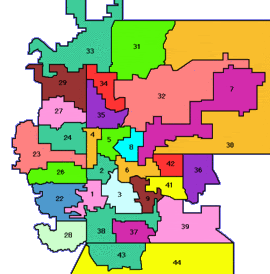
Also, the guys at Soap Blox have done a great job with some interactive maps. Here is a link to their page.
Friday, May 12, 2006
Brian Peppers!!!
We are taking today off, look for a finished profile of all 65 house seats and all of the state senate seats by monday, plus you will get a competitive race chart and maps.

Wednesday, May 10, 2006
Delphi on the Colorado State House 2006
Denver County (HD 1-9), Boulder (HD 10-13), Colorado Springs (HD 14-21), Jeffco (HD 22-29), Adams, Arapaho & Douglas Counties (HD 30-45), Parts of Pueblo (HD 46 & 47), Larimer and Weld Counties (HD 48-53), Mountains and West Slope (HD 54-62)and the Eastern Plains (HD 63-65).
Partisan Differential=Registration advantage as a percentage between the two parties. For example, if 35% of the Registered voters are Republican and 30% are Democrat than the Partisan Differential will be R +5.
Any time the model spits out a probability either equal to or above 100% we call the race "Safe" and any probability between 59% and 50% is a "TOSS UP".
This model is woefully incomplete right now. It only uses two variables (PDiff and a bivariate code for who won) and it only uses data from 2004. Version two will be out within a fortnight and it will include 2002 data plus other variables if they are statistically significant.
Colorado House Phase 1 Chart
Partisan Differential=Registration advantage as a percentage between the two parties. For example, if 35% of the Registered voters are Republican and 30% are Democrat than the Partisan Differential will be R +5.
Any time the model spits out a probability either equal to or above 100% we call the race "Safe" and any probability between 59% and 50% is a "TOSS UP".
This model is woefully incomplete right now. It only uses two variables (PDiff and a bivariate code for who won) and it only uses data from 2004. Version two will be out within a fortnight and it will include 2002 data plus other variables if they are statistically significant.
Colorado House Phase 1 Chart
Monday, May 08, 2006
Phase one done, predictions for each State House District coming...
Our current model looks like this:
Y=4.5675 * X + -.3446
Y= the probability that either a Democrat will win in the district (-1) or that a Republican will win (1).
X=the registration advantage one party has over the other.
According to this model the Democrats have six seats that, logically, if independents voted 50-50, should be Republican due to registration advantages. The Republicans have no seats that have a Democratic advantage.
It also appears that during the 2004 election the Democrats won on average of 60% of the unaffiliated vote.
However, this still needs some work, since this model only explains about 60% of the variation in Y.
Y=4.5675 * X + -.3446
Y= the probability that either a Democrat will win in the district (-1) or that a Republican will win (1).
X=the registration advantage one party has over the other.
According to this model the Democrats have six seats that, logically, if independents voted 50-50, should be Republican due to registration advantages. The Republicans have no seats that have a Democratic advantage.
It also appears that during the 2004 election the Democrats won on average of 60% of the unaffiliated vote.
However, this still needs some work, since this model only explains about 60% of the variation in Y.
Saturday, May 06, 2006
Thursday, May 04, 2006
Colorado State Legislature Projection Update Coming on Friday.
We've set up a Photobucket account so that we can give you maps a la Election Projection.
I'll be completely redoing our state legislative projections. This will be phase one. In it I will build a model that will predict the likelihood of either a Democrat or a Republican winning in a given district based upon a model created from the October 2004 voter registration numbers.
This will give us a base-line for competitive and non-competitive districts.
In phase two I'll be adding in the 2002 voter registration numbers (as soon as the SOS's office gets them to me).
In phase three I'll add in fundraising numbers.
Throughout I'll be making sure that the statistics I use are statistically significant.
These models will be powered by Open Office.
I'll be completely redoing our state legislative projections. This will be phase one. In it I will build a model that will predict the likelihood of either a Democrat or a Republican winning in a given district based upon a model created from the October 2004 voter registration numbers.
This will give us a base-line for competitive and non-competitive districts.
In phase two I'll be adding in the 2002 voter registration numbers (as soon as the SOS's office gets them to me).
In phase three I'll add in fundraising numbers.
Throughout I'll be making sure that the statistics I use are statistically significant.
These models will be powered by Open Office.
Sunday, April 30, 2006
Updated Congressional Makeup.
Here is our newest projection for what the makeup of the US House will look like after election day.
Republicans: 220 Net Loss of 12 Seats
Democrats: 215* (Net Gain of 12 Seats, still 3 seats short of majority)
With only three seats to spare this race is officially moved into the toss-up category.
*NJ (13) will remain vacant until a special election in January of 2007, but it is a safe Democratic seat. So we have counted it towards the Democratic total.
Republicans: 220 Net Loss of 12 Seats
Democrats: 215* (Net Gain of 12 Seats, still 3 seats short of majority)
With only three seats to spare this race is officially moved into the toss-up category.
*NJ (13) will remain vacant until a special election in January of 2007, but it is a safe Democratic seat. So we have counted it towards the Democratic total.
Thursday, April 27, 2006
Top of the Ticket and Congressional Odds updated.
We have moved the Colorado Governor's race from the "Leans GOP" category into the "Barely GOP" category.
Larry Sabato has the race listed as a toss-up.
Coloradopols has the race leaning Democratic.
It appears that the GOP will hold the Senate in the fall, but the House could switch parties. Support for the GOP has collapsed since our last update.
We are going to do an analysis over the weekend and give an updated projection on Sunday.
Larry Sabato has the race listed as a toss-up.
Coloradopols has the race leaning Democratic.
It appears that the GOP will hold the Senate in the fall, but the House could switch parties. Support for the GOP has collapsed since our last update.
We are going to do an analysis over the weekend and give an updated projection on Sunday.
MHD's mission statement:
Mile High Delphi is dedicated to predicting the outcomes of Colorado State elections and United States elections with a 95% accuracy. Not just polling, but honest to god proven econometric models will be used to figure out the winners before the voters can. One Liberal and one Conservative cutting through the mess that is the media to give you the news you need.
Updated odds for control of Congress after 2006.
Back on November 22 we opened our odds for control of Congress by using the probabilities from Tradesports as a proxy. We are going to continue that for the aggregate probabilities, while releasing some calls on individual races on an ad hoc basis.
Here is where things stood on November 22:
Things have changed somewhat.
Here is a chart of the prices for options on the GOP retaining control of the US Senate:

The current probability of GOP control of the US Senate has actually risen to 79.7%
Things are dramatically different for the US House:

The market at Tradesports only gives the GOP a 53% chance of retaining the US House. That is a dramatic change from the 72% probability they had in November.
Here is where things stood on November 22:
Currently the GOP is favored to keep control of both the House and the Senate.
Senate Probability of GOP Control: 74.2% Fractional: 5/14
House Probability of GOP Control: 72.8% Fractional: 4/11
Things have changed somewhat.
Here is a chart of the prices for options on the GOP retaining control of the US Senate:
The current probability of GOP control of the US Senate has actually risen to 79.7%
Things are dramatically different for the US House:
The market at Tradesports only gives the GOP a 53% chance of retaining the US House. That is a dramatic change from the 72% probability they had in November.
Wednesday, April 26, 2006
We are under 200 days until the election, time to get going.
Tomorrow we will start with a new look at the national elections, looks like some major revisions may be needed.
We will then look at the state races, race by race.
Early next week we will release probabilities for each race.
We will then look at the state races, race by race.
Early next week we will release probabilities for each race.
Sunday, March 19, 2006
The Cauci are coming!
Just in case your one of the few who go to your caucus here is a link to Coloradopols so that you can find your location.
Tuesday, March 14, 2006
237 days until election day 2006.
We are still here. Just getting ready for spring break in Mazatlan (Even though we are all out of grad school, after a few shots of tequila the girls can't tell).
We are working on getting a new computer and a new website. We want this site to be on par with electionprojection.com.
Anyway, you can click here to find out how far we are from election day.
We are working on getting a new computer and a new website. We want this site to be on par with electionprojection.com.
Anyway, you can click here to find out how far we are from election day.
Friday, January 13, 2006
Wednesday, January 11, 2006
Delphi Intelligence Unit
This is the page where the magic will happen.
As we spit out new projections, all updates will end up here.
Updated 01/12/06
Our current projections for the Colorado Legislature:
House: R 28-33 D 32-37
Analysis: Our initial projection shows that the GOP has quite a hill to climb in order to regain control of the house (they need to net three seats).
Senate: R 16-18 D 16-18
Analysis: Control of the State Senate is up in the air until we get a candidate line up and a look at some fundraising numbers.
As we spit out new projections, all updates will end up here.
Updated 01/12/06
Our current projections for the Colorado Legislature:
House: R 28-33 D 32-37
Analysis: Our initial projection shows that the GOP has quite a hill to climb in order to regain control of the house (they need to net three seats).
Senate: R 16-18 D 16-18
Analysis: Control of the State Senate is up in the air until we get a candidate line up and a look at some fundraising numbers.
Tuesday, January 10, 2006
Colorado State Senate Home Page
Update March, 19, 2008
Look at competitive State Senate Races


The Colorado State Senate (hereto after referred to simply as the “Senate”) is made up of 35 members. Each member is elected to a four year term, and term limits state that no member shall serve more than two terms. Due to appointments and a court ruling a Senator can serve up to ten years, but in the vast majority of circumstances you can group Senators into one of two groups, either a first termer or a last termer. Elections are staggered for the Senate, with 18 seats up during presidential election years and 17 seats up during mid-term elections. The 18 seats that are up during presidential election years will be referred to as Class 1 and the remaining 17 Class 2 seats will be decided during the midterm elections two years later. The Senate is currently made up of only Republicans and Democrats. The Democrats have a five seat majority, meaning that the GOP must win three seats in order to take control of the chamber in 2009.
The Class 2 seats currently are made up of 8 Republicans and 9 Democrats. Of the Class 1 seats up for election during this cycle 14 of the seats are not competitive. Below we list the Senate Districts based upon their “partisan differential.” The P-Diff as we call it is basically either the Democratic or Republican Party’s registration advantage as a percentage.
Before we begin with a look at each Senate District in particular, let’s just do a quick macro view of the political landscape in Colorado. In 2004 the Democratic Party took control of the State Legislature for the first time in forty years. Colorado has moderated greatly since the beginning of Bush 41’s Presidency. All things being equal you would expect that if the registration between the two parties is equal, i.e. the P-Diff is 0, than each party would have an equal chance of winning the district. Today that is not true in Colorado. The “horizon” as we call it is currently somewhere out near R +7. That means that demographically, districts where the GOP has a 7% registration advantage are “toss ups.” As a matter of fact the GOP only holds one Senate District where they have less than a 9% registration advantage, SD 2 in southeast Colorado, which has a P Diff of R +2. Basically, the GOP has to slug it out in order to win districts where it holds single digit registration advantages, while Democrats easily skate to victory in comparable districts. As things stand right now, we only see four competitive districts this cycle, with each party having to defend two seats each. Since the GOP needs three seats to capture control of the Senate we put the probability of the GOP taking control of the Senate at 1%.
Our current projection is Democratic control: R 13-16 D 19-22
Here is a look at the four most competitive districts:
SD 19:
Open. P-Diff R +5.5. Westminster. Formerly held by Sue Windels (D) for eight years.
SD 23:
Open. P-Diff R +9. Broomfield. Shawn Mitchell (R) Running for re-election.
SD 8:
Open. P-Diff R +9. Northwestern Colorado. Formerly held by Jack Taylor (R) for eight years.
SD 14:
Incumbent Bob Bacon (D) is running for re-election. P-Diff R+2.5. Fort Collins.
Look at competitive State Senate Races


The Colorado State Senate (hereto after referred to simply as the “Senate”) is made up of 35 members. Each member is elected to a four year term, and term limits state that no member shall serve more than two terms. Due to appointments and a court ruling a Senator can serve up to ten years, but in the vast majority of circumstances you can group Senators into one of two groups, either a first termer or a last termer. Elections are staggered for the Senate, with 18 seats up during presidential election years and 17 seats up during mid-term elections. The 18 seats that are up during presidential election years will be referred to as Class 1 and the remaining 17 Class 2 seats will be decided during the midterm elections two years later. The Senate is currently made up of only Republicans and Democrats. The Democrats have a five seat majority, meaning that the GOP must win three seats in order to take control of the chamber in 2009.
The Class 2 seats currently are made up of 8 Republicans and 9 Democrats. Of the Class 1 seats up for election during this cycle 14 of the seats are not competitive. Below we list the Senate Districts based upon their “partisan differential.” The P-Diff as we call it is basically either the Democratic or Republican Party’s registration advantage as a percentage.
Before we begin with a look at each Senate District in particular, let’s just do a quick macro view of the political landscape in Colorado. In 2004 the Democratic Party took control of the State Legislature for the first time in forty years. Colorado has moderated greatly since the beginning of Bush 41’s Presidency. All things being equal you would expect that if the registration between the two parties is equal, i.e. the P-Diff is 0, than each party would have an equal chance of winning the district. Today that is not true in Colorado. The “horizon” as we call it is currently somewhere out near R +7. That means that demographically, districts where the GOP has a 7% registration advantage are “toss ups.” As a matter of fact the GOP only holds one Senate District where they have less than a 9% registration advantage, SD 2 in southeast Colorado, which has a P Diff of R +2. Basically, the GOP has to slug it out in order to win districts where it holds single digit registration advantages, while Democrats easily skate to victory in comparable districts. As things stand right now, we only see four competitive districts this cycle, with each party having to defend two seats each. Since the GOP needs three seats to capture control of the Senate we put the probability of the GOP taking control of the Senate at 1%.
Our current projection is Democratic control: R 13-16 D 19-22
Here is a look at the four most competitive districts:
SD 19:
Open. P-Diff R +5.5. Westminster. Formerly held by Sue Windels (D) for eight years.
SD 23:
Open. P-Diff R +9. Broomfield. Shawn Mitchell (R) Running for re-election.
SD 8:
Open. P-Diff R +9. Northwestern Colorado. Formerly held by Jack Taylor (R) for eight years.
SD 14:
Incumbent Bob Bacon (D) is running for re-election. P-Diff R+2.5. Fort Collins.
Tuesday, December 20, 2005
State House Closest Races 2004
District Party in Power Win Margin % Win Margin Raw Number
HD 23 Democrat .2% 41
HD 52 Republican 1.3% 484
HD 29 Democrat 1.8% 520
HD 47 Democrat 3.6% 1107
HD 22 Republican 3.6% 1157
HD 31 Democrat 3.4% 1177
HD 27 Republican 4% 1307
HD 50 Democrat 6.2% 1356
HD 30 Democrat 7.8% 1490
HD 64 Democrat 7.4% 1929
HD 33 Republican 5.4% 1972
HD 36 Democrat 36 10.4% 2483
HD 23 Democrat .2% 41
HD 52 Republican 1.3% 484
HD 29 Democrat 1.8% 520
HD 47 Democrat 3.6% 1107
HD 22 Republican 3.6% 1157
HD 31 Democrat 3.4% 1177
HD 27 Republican 4% 1307
HD 50 Democrat 6.2% 1356
HD 30 Democrat 7.8% 1490
HD 64 Democrat 7.4% 1929
HD 33 Republican 5.4% 1972
HD 36 Democrat 36 10.4% 2483
Colorado State House Highest Turnout 2004
HD 43 96.54%
HD 44 96.03%
HD 37 95.58%
HD 45 94.95%
HD 65 93.93%
HD 38 93.68%
HD 33 93.13%
HD 25 92.92%
HD 20 92.64%
HD 31 92.61%
HD 48 92.40%
HD 40 91.66%
HD 44 96.03%
HD 37 95.58%
HD 45 94.95%
HD 65 93.93%
HD 38 93.68%
HD 33 93.13%
HD 25 92.92%
HD 20 92.64%
HD 31 92.61%
HD 48 92.40%
HD 40 91.66%
Monday, December 12, 2005
Friday, December 09, 2005
Colorado House Homepage.
The Colorado House has 65 members. Currently the Democrats hold the majority 35-30. 33 seats are needed for conrol. Over the next few weeks each district will be examined, triage will occur, and we will come up with a competitive race chart...
...............THIS PAGE IS STILL UNDER CONSTRUCTION......................
Last Update 12/12/2005
Seven County Metro Area (Currently 11-R 25-D):
Adams County: 1-R 5-D
HD-30 Likely Democrat
HD-31 Competitive Democrat
HD-32 Likely Democrat
HD-33 Very Competitive Republican
HD-34 Non Competitive Democrat
HD-35 Non Competitive Democrat
Denver County: 0-R 9-D
HD-01 Non Competitive Democrat
HD-02 Non Competitive Democrat
HD-03 Non Competitive Democrat
HD-04 Non Competitive Democrat
HD-05 Non Competitive Democrat
HD-06 Non Competitive Democrat
HD-07 Non Competitive Democrat
HD-08 Non Competitive Democrat
HD-09 Non Competitive Democrat
Jefferson County W/ Broomfield: 4-R 4-D
HD-22 Very Competitive Republican
HD-23 Very Competitive Democrat
HD-24 Likely Democrat
HD-25 Likely Republican
HD-26 Likely Democrat
HD-27 Very Competitive Republican
HD-28 Likely Republican
HD-29 Very Competitive Democrat
Western Region: 5-R 3-D
HD-54 Non Competitive Republican
HD-55 Competitive Democrat
HD-56 Likely Democrat
HD-57 Non Competitive Republican
HD-58 Likely Republican
HD-59 Likely Republican
HD-60 Non Competitive Republican
HD-61 Likely Democrat
Northern & Eastern Regions: 6-R 2-D
HD-48 Non Competitive Republican
HD-49 Competitive Republican
HD-50 Competitive Democrat
HD-51 Non Competitive Republican
HD-52 Very Competitive Republican
HD-53 Non Competitive Democrat
HD-63 Non Competitive Republican
HD-65 Non Competitive Republican
Southern Region: 8-R 5-D
HD-14 Non Competitive Republican
HD-15 Non Competitive Republican
HD-16 Non Competitive Republican
HD-17 Non Competitive Republican
HD-18 Competitive Democrat
HD-19 Non Competitive Republican
HD-20 Non Competitive Republican
HD-21 Non Competitive Republican
HD-45 Non Competitive Republican
HD-46 Non Competitive Democrat
HD-47 Very Competitive Democrat
HD-62 Non Competitive Democrat
HD-64 Competitive Democrat
Competitive Race Chart:
Non Competitive & Likely Republican: Total 25 HD 14-17, 19-21, 25, 28, 37-40, 43-45, 48, 51, 54, 57-60, 63 & 65.
Competitive Republican: Total 1 HD 49.
Very Competitive Republican: Total 4 HD 22, 27, 33 & 52.
Very Competitive Democrat: Total 4 HD 23, 29, 31 & 47.
Competitive Democrat: Total 5 HD 18, 50, 55, 56, 64.
Non Competitive & Likely Democrat: Total 26 HD 1-13, 24, 26, 30, 32, 34-36, 41, 42, 46, 53, 61 & 62.
BETA Projected Makeup of Colorado State House: R 28-33 D 32-37
...............THIS PAGE IS STILL UNDER CONSTRUCTION......................
Last Update 12/12/2005
Seven County Metro Area (Currently 11-R 25-D):
Adams County: 1-R 5-D
HD-30 Likely Democrat
HD-31 Competitive Democrat
HD-32 Likely Democrat
HD-33 Very Competitive Republican
HD-34 Non Competitive Democrat
HD-35 Non Competitive Democrat
Denver County: 0-R 9-D
HD-01 Non Competitive Democrat
HD-02 Non Competitive Democrat
HD-03 Non Competitive Democrat
HD-04 Non Competitive Democrat
HD-05 Non Competitive Democrat
HD-06 Non Competitive Democrat
HD-07 Non Competitive Democrat
HD-08 Non Competitive Democrat
HD-09 Non Competitive Democrat
Jefferson County W/ Broomfield: 4-R 4-D
HD-22 Very Competitive Republican
HD-23 Very Competitive Democrat
HD-24 Likely Democrat
HD-25 Likely Republican
HD-26 Likely Democrat
HD-27 Very Competitive Republican
HD-28 Likely Republican
HD-29 Very Competitive Democrat
Western Region: 5-R 3-D
HD-54 Non Competitive Republican
HD-55 Competitive Democrat
HD-56 Likely Democrat
HD-57 Non Competitive Republican
HD-58 Likely Republican
HD-59 Likely Republican
HD-60 Non Competitive Republican
HD-61 Likely Democrat
Northern & Eastern Regions: 6-R 2-D
HD-48 Non Competitive Republican
HD-49 Competitive Republican
HD-50 Competitive Democrat
HD-51 Non Competitive Republican
HD-52 Very Competitive Republican
HD-53 Non Competitive Democrat
HD-63 Non Competitive Republican
HD-65 Non Competitive Republican
Southern Region: 8-R 5-D
HD-14 Non Competitive Republican
HD-15 Non Competitive Republican
HD-16 Non Competitive Republican
HD-17 Non Competitive Republican
HD-18 Competitive Democrat
HD-19 Non Competitive Republican
HD-20 Non Competitive Republican
HD-21 Non Competitive Republican
HD-45 Non Competitive Republican
HD-46 Non Competitive Democrat
HD-47 Very Competitive Democrat
HD-62 Non Competitive Democrat
HD-64 Competitive Democrat
Competitive Race Chart:
Non Competitive & Likely Republican: Total 25 HD 14-17, 19-21, 25, 28, 37-40, 43-45, 48, 51, 54, 57-60, 63 & 65.
Competitive Republican: Total 1 HD 49.
Very Competitive Republican: Total 4 HD 22, 27, 33 & 52.
Very Competitive Democrat: Total 4 HD 23, 29, 31 & 47.
Competitive Democrat: Total 5 HD 18, 50, 55, 56, 64.
Non Competitive & Likely Democrat: Total 26 HD 1-13, 24, 26, 30, 32, 34-36, 41, 42, 46, 53, 61 & 62.
BETA Projected Makeup of Colorado State House: R 28-33 D 32-37
Wednesday, December 07, 2005
Southern Region of the United States.
We have divided the United States into four regions in order to more effectively go about our state-by-state analysis.
Our southern region consists of Texas, Louisiana, Mississippi, Alabama, Georgia, Florida, South Carolina, North Carolina, Tennesse and Arkansas. The southern region consists of 10 states that account for 120 of the 435 members of congress (27.6%).
Macro: Of the 120 House members that represent this region, 49 are Democrats and 71 are Republicans. This region's Senate delegation is made up of 16 Republicans and 4 Democrats. This region accounts for 27.6% of the US House and 20% of the United States Senate. John Kerry did not carry a single southern state in 2004.
Micro: This region only has ten competitive House races.
TX-17 Rep. Edwards (D) 8th Term 2004: % of vote 47% R 51% D CPI R+18
TX-22 Rep. DeLay (R) 11th Term 2004: % of vote 55% R 41% D CPI R+15
LA-7 Rep. Boustany (R) Freshman 2004: % of vote 55% R 45% D CPI R+7
LA-3 Rep. Melancon (D) Freshman 2004: % of vote 50% R 50% D CPI R+5
GA-12 Rep. Barrow (D)Freshman 2004: % of vote 48% R 52% D CPI D+5
GA-8 Rep. Marshall (D) Freshman 2004: % of vote NA% R NA% D CPI R+21
FL-9 OPEN 2004: Republican Unopposed CPI R+4
FL-13 OPEN 2004: % of vote 55% R 45% D CPI R+4
FL-22 Rep. Shaw (R) 13th Term 2004: % of vote 63% R 35% D CPI D+4
NC-11 Taylor (R) 8th Term 2004: % of vote 55% R 45% D CPI R+7
Our southern region consists of Texas, Louisiana, Mississippi, Alabama, Georgia, Florida, South Carolina, North Carolina, Tennesse and Arkansas. The southern region consists of 10 states that account for 120 of the 435 members of congress (27.6%).
Macro: Of the 120 House members that represent this region, 49 are Democrats and 71 are Republicans. This region's Senate delegation is made up of 16 Republicans and 4 Democrats. This region accounts for 27.6% of the US House and 20% of the United States Senate. John Kerry did not carry a single southern state in 2004.
Micro: This region only has ten competitive House races.
TX-17 Rep. Edwards (D) 8th Term 2004: % of vote 47% R 51% D CPI R+18
TX-22 Rep. DeLay (R) 11th Term 2004: % of vote 55% R 41% D CPI R+15
LA-7 Rep. Boustany (R) Freshman 2004: % of vote 55% R 45% D CPI R+7
LA-3 Rep. Melancon (D) Freshman 2004: % of vote 50% R 50% D CPI R+5
GA-12 Rep. Barrow (D)Freshman 2004: % of vote 48% R 52% D CPI D+5
GA-8 Rep. Marshall (D) Freshman 2004: % of vote NA% R NA% D CPI R+21
FL-9 OPEN 2004: Republican Unopposed CPI R+4
FL-13 OPEN 2004: % of vote 55% R 45% D CPI R+4
FL-22 Rep. Shaw (R) 13th Term 2004: % of vote 63% R 35% D CPI D+4
NC-11 Taylor (R) 8th Term 2004: % of vote 55% R 45% D CPI R+7
Thursday, December 01, 2005
Western Region of the United States.
We have divided the United States into four regions in order to more effectively go about our state-by-state analysis.
Our western region consists of Alaska, Hawaii, California, Oregon, Washington, Idaho, Nevada, Arizona, Utah, New Mexico, Colorado, Wyoming and Montana. Thirteen states that account for 98 of the 435 members of congress.
Macro: Of the 98 House members that represent this region, 53 are Democrats and 45 are Republicans. However, this region's Senate delegation is made up of 15 Republicans and 11 Democrats. This region accounts for 22.5% of the US House and 26% of the United States Senate. This region voted 9-4 in favor of President Bush in 2004.
Micro: This region only has five competitive House races.
WA-8 Rep. Reichert (R) Freshman. 2004: % of vote 52% R 47% D CPI D+2
WA-2 Rep. Larson (D) 3rd Term 2004: % of vote 34% R 64% D CPI D+3 w/ nominal opp.
NM-1 Rep. Wilson (R) 4th Term 2004: % of vote 54% R 46% D CPI D+2
CO-3 Rep. Salazar (D) Freshman. 2004: % of vote 47% R 51% D CPI R+6
CO-7 OPEN 2004: % of vote 55% R 43% D CPI D+2
It also appears that there will be two competitive Senate elections, Montana and Washington.
Our western region consists of Alaska, Hawaii, California, Oregon, Washington, Idaho, Nevada, Arizona, Utah, New Mexico, Colorado, Wyoming and Montana. Thirteen states that account for 98 of the 435 members of congress.
Macro: Of the 98 House members that represent this region, 53 are Democrats and 45 are Republicans. However, this region's Senate delegation is made up of 15 Republicans and 11 Democrats. This region accounts for 22.5% of the US House and 26% of the United States Senate. This region voted 9-4 in favor of President Bush in 2004.
Micro: This region only has five competitive House races.
WA-8 Rep. Reichert (R) Freshman. 2004: % of vote 52% R 47% D CPI D+2
WA-2 Rep. Larson (D) 3rd Term 2004: % of vote 34% R 64% D CPI D+3 w/ nominal opp.
NM-1 Rep. Wilson (R) 4th Term 2004: % of vote 54% R 46% D CPI D+2
CO-3 Rep. Salazar (D) Freshman. 2004: % of vote 47% R 51% D CPI R+6
CO-7 OPEN 2004: % of vote 55% R 43% D CPI D+2
It also appears that there will be two competitive Senate elections, Montana and Washington.
Monday, November 28, 2005
In the hopper...
Three projects are going on at the same time here at MHD.
First Matrow is finishing his work on determining if there is a correlation between how a county voted in the 2004 Presidential election and how it voted in the Referendum C election. When he's done I'll set up a table over at polstate.com. We are also working on creating a few jpg maps.
Second, we will begin doing our state-by-state analysis of the 2006 election. At the same time we will also do a systematic analysis of the Colorado State House and State Senate races.
Thirdly, we've got a project in the hopper that will be reviewing a report that we keep seeing in the local papers.
We will release the state-by-state analysis beginning this week.
Meanwhile, here is an exclusive look at how Prof. Snape killed Dumbledore.
First Matrow is finishing his work on determining if there is a correlation between how a county voted in the 2004 Presidential election and how it voted in the Referendum C election. When he's done I'll set up a table over at polstate.com. We are also working on creating a few jpg maps.
Second, we will begin doing our state-by-state analysis of the 2006 election. At the same time we will also do a systematic analysis of the Colorado State House and State Senate races.
Thirdly, we've got a project in the hopper that will be reviewing a report that we keep seeing in the local papers.
We will release the state-by-state analysis beginning this week.
Meanwhile, here is an exclusive look at how Prof. Snape killed Dumbledore.
Tuesday, November 22, 2005
Opening Odds on Control of Congress in 2006...
We are using Tradesports current market prices to set our opening odds for control of the United States Senate and House.
Currently the GOP is favored to keep control of both the House and the Senate.
Senate Probability of GOP Control: 74.2% Fractional: 5/14
House Probability of GOP Control: 72.8% Fractional: 4/11
Over the course of the winter we will be doing a state by state analysis of all 435 House seats and all of the open Senate seats. This analysis will be cross posted at polstate.com.
Currently the GOP is favored to keep control of both the House and the Senate.
Senate Probability of GOP Control: 74.2% Fractional: 5/14
House Probability of GOP Control: 72.8% Fractional: 4/11
Over the course of the winter we will be doing a state by state analysis of all 435 House seats and all of the open Senate seats. This analysis will be cross posted at polstate.com.
Monday, November 21, 2005
Referendum C State-Wide Analysis...
Here is our complete initial analysis of the 2005 Referenda C and D election. We are dividing Colorado into five regions, the Denver Metro Area, Northern Region, Eastern Region, Southern Region and the Western Region.
Referendum C:
State-Wide Yes 52.0% No 48.0%
Metro Area Yes 54.1% No 45.9% MHD Index = +2.1
Northern Region Yes 52.1% No 47.9% MHD Index = +.1
Southern Region Yes 48.7% No 51.3% MHD Index = -3.3
Eastern Region Yes 42.8% No 57.2% MHD Index = -9.2
Western Region Yes 56.8% No 43.2% MHD Index = +4.8
Referendum C:
State-Wide Yes 52.0% No 48.0%
Metro Area Yes 54.1% No 45.9% MHD Index = +2.1
Northern Region Yes 52.1% No 47.9% MHD Index = +.1
Southern Region Yes 48.7% No 51.3% MHD Index = -3.3
Eastern Region Yes 42.8% No 57.2% MHD Index = -9.2
Western Region Yes 56.8% No 43.2% MHD Index = +4.8
Western Region.
Our Western Region consists of 27 counties: Archuletta, Chaffee, Clear Creek, Delta, Dolores, Eagle, Garfield, Gilpin, Grand, Gunnison, Hinsdale, Jackson, Lake, La Plata, Mesa, Mineral, Moffat, Montezuma, Montrose, Ouray, Park, Pitkin, Rio Blanco, Routt, San Juan, San Miguel, Summit.
Referendum C Won in the Western Region 56.8-43.2. The Eastern Region accounted for 17% of the total state-wide vote.
Referendum C Won in the Western Region 56.8-43.2. The Eastern Region accounted for 17% of the total state-wide vote.
Eastern Region.
Our Eastern Region is made up of 16 counties: Baca, Bent, Cheyenne, Crowley, Elbert, Kiowa, Kit Carson, Lincoln, Logan, Morgan, Otero, Phillips, Prowlers, Sedgewick, Washington and Yuma.
Referendum C Lost in the Eastern Region 42.8-57.2. The Eastern Region accounted for 5% of the total state-wide vote.
The maximum percentage of the vote that Referendum C got in any county was 69.5%, the minimum was 31.4%, with a mean of 51.3%.
Referendum C Lost in the Eastern Region 42.8-57.2. The Eastern Region accounted for 5% of the total state-wide vote.
The maximum percentage of the vote that Referendum C got in any county was 69.5%, the minimum was 31.4%, with a mean of 51.3%.
Thursday, November 17, 2005
More Referendum C Goodness.
Last week we looked at how the seven county Denver Metro Area voted in the Referendum C campaign.
The Denver Metro Area cast 53% of the total ballots.
Referendum C passed in the Denver Metro Area 54.1-45.9 vs. a State-wide vote of 52-48.
Our Northern Region consists of two counties, Larimer and Weld. In this Region Referendum C passed 52.1-47.1 and it accounted for 11% of the state-wide vote.
Our Southern Region consists of eleven counties. In this Region Referendum C lost 48.7-51.3 and it accounted for 17% of the state-wide vote.
On Monday we will go over the Eastern and Western Regions.
Later in the week we will look for correlations between each county's MHD Diff. and its Cook Partisanship Index.
In the meantime, look here for some G rated Paris Hilton goodness.
The Denver Metro Area cast 53% of the total ballots.
Referendum C passed in the Denver Metro Area 54.1-45.9 vs. a State-wide vote of 52-48.
Our Northern Region consists of two counties, Larimer and Weld. In this Region Referendum C passed 52.1-47.1 and it accounted for 11% of the state-wide vote.
Our Southern Region consists of eleven counties. In this Region Referendum C lost 48.7-51.3 and it accounted for 17% of the state-wide vote.
On Monday we will go over the Eastern and Western Regions.
Later in the week we will look for correlations between each county's MHD Diff. and its Cook Partisanship Index.
In the meantime, look here for some G rated Paris Hilton goodness.
Friday, November 11, 2005
Regional Analysis of the 2005 Referenda C and D Election.
Over the next week we will be releasing an analysis of the 2005 Referenda C and D election. We are dividing Colorado into five regions, the 7 county Denver Metro Area, North Central, Eastern Plains, South Central and the Mountains.
11/11/2005
7 County Denver Metro Area:
Referendum C:
State-Wide Yes 52.0% No 48.0%
Metro Area Yes 54.1% No 45.9%
MHD Index = +2.1
Source: Colorado SOS.
11/11/2005
7 County Denver Metro Area:
Referendum C:
State-Wide Yes 52.0% No 48.0%
Metro Area Yes 54.1% No 45.9%
MHD Index = +2.1
Source: Colorado SOS.
Thursday, November 10, 2005
In the hopper...
We are going to start doing updates about once a week (either on Mondays or Fridays). Tomorrow we will release a regional analysis of the Referendum C and D election.
After that we will begin our predictions for the Colorado State Senate, Colorado State House, United States Senate and United States House contests and we will start our war on the statistical illiterati.
After that we will begin our predictions for the Colorado State Senate, Colorado State House, United States Senate and United States House contests and we will start our war on the statistical illiterati.
Friday, November 04, 2005
Looking at the Governor Races of 2005.
In 2005 there are only two races for Governor in the United States, New Jersey and Virginia.
According to Tradesports.com the Democrats have a 1/13 chance of winning the seat. That's a 93% probability.
Also according to Tradesports.com the Virginia race looks like a toss-up.
You can go here to look at Prof. Larry Sabato's analysis of these races. The GOP currently has a 28-22 advantage over the Democrats in Governorships. If the GOP picks up either Virginia or New Jersey it will increase that margin.
According to Tradesports.com the Democrats have a 1/13 chance of winning the seat. That's a 93% probability.
Also according to Tradesports.com the Virginia race looks like a toss-up.
You can go here to look at Prof. Larry Sabato's analysis of these races. The GOP currently has a 28-22 advantage over the Democrats in Governorships. If the GOP picks up either Virginia or New Jersey it will increase that margin.
Thursday, November 03, 2005
Caldara gives post election analysis; echoes MHD...
As you may know from our pre-election analysis, it is our belief that Independence Institute President Jon Caldara is one of the two consuls for the Republican side in Colorado's current political war.
Last night on his 850 KOA radio show Jon Caldara lead what was a mixture of post election analysis, pep rally and a wake.
He began by stating that he felt like "he let [his supporters] down" by losing the battle over Referendum C while he claimed a partial victory in the defeat of Referendum D. "We didn't do that bad considering that we faced the entire Democratic establishment and a minority of the GOP."
When it came to his actual analysis he said that "the state is moving to the left."
He cited Public Choice Theory as the reason for the Referendum C victory. "Had this election taken place during a even-year this wouldn't have even been close...we matched them in the air war but we lost the ground war...we have no GOTV."
A caller called in and dubbed yesterday the "2nd Black Wednesday" referring to the Caldara legion's loss. Caldara asked what the 1st Black Wednesday was. "A year ago," replied the caller. "Yes, your right" stated Caldara, "A year ago we lost the State Legislature, a Congress Seat and a Senate Seat." We call that election Colorado's Cannae, but "Black Wednesday" certainly has a ring to it.
Caldara also gave special congratulations to two supporters of Referendum C. He stated that without the support of Governor Owens, bringing his GOP legions over to the pro-C side, the ballot item wouldn't have passed. He also stated that the tracking polls showed that when Denver Mayor John Hickenlooper jumped out of the plane, support for C jumped.
Last night on his 850 KOA radio show Jon Caldara lead what was a mixture of post election analysis, pep rally and a wake.
He began by stating that he felt like "he let [his supporters] down" by losing the battle over Referendum C while he claimed a partial victory in the defeat of Referendum D. "We didn't do that bad considering that we faced the entire Democratic establishment and a minority of the GOP."
When it came to his actual analysis he said that "the state is moving to the left."
He cited Public Choice Theory as the reason for the Referendum C victory. "Had this election taken place during a even-year this wouldn't have even been close...we matched them in the air war but we lost the ground war...we have no GOTV."
A caller called in and dubbed yesterday the "2nd Black Wednesday" referring to the Caldara legion's loss. Caldara asked what the 1st Black Wednesday was. "A year ago," replied the caller. "Yes, your right" stated Caldara, "A year ago we lost the State Legislature, a Congress Seat and a Senate Seat." We call that election Colorado's Cannae, but "Black Wednesday" certainly has a ring to it.
Caldara also gave special congratulations to two supporters of Referendum C. He stated that without the support of Governor Owens, bringing his GOP legions over to the pro-C side, the ballot item wouldn't have passed. He also stated that the tracking polls showed that when Denver Mayor John Hickenlooper jumped out of the plane, support for C jumped.
Wednesday, November 02, 2005
Split Decision!!!
Update 16:30:
Look to the right for a report card on how Mile High Delphi did this election cycle. Our sophomore effort looked pretty good (simple models work better than big complex ones). Now we need to focus on the State Legislature...
Update 15:45:
We've done a breakdown of our B Market. The predicted results for the percentage of the vote for Referendum C was 51.12%. The actual election result was (with 99.9% of precincts reporting) 52.03%. A difference of .91%. Not too bad, with 58 participants it sure did get close.
Original post:
The results are in and it appears that Referendum C passed and its sister item Referendum D failed.
It is our belief that this will set up a great battle in 2006 (since this election was basically fought to a stalemate).
We will have analysis of the election up throughout the weekend. I'm working on a color-coded map of Colorado (we will put it up both here and at polstate.com), Blogicus is working on a regression model, and our newest partner, Salacious Crumb, will be typing up the analysis.
We will also have the results of our markets and our winners up.
Early next week we will have a look at other elections across the United States.
Look to the right for a report card on how Mile High Delphi did this election cycle. Our sophomore effort looked pretty good (simple models work better than big complex ones). Now we need to focus on the State Legislature...
Update 15:45:
We've done a breakdown of our B Market. The predicted results for the percentage of the vote for Referendum C was 51.12%. The actual election result was (with 99.9% of precincts reporting) 52.03%. A difference of .91%. Not too bad, with 58 participants it sure did get close.
Original post:
The results are in and it appears that Referendum C passed and its sister item Referendum D failed.
It is our belief that this will set up a great battle in 2006 (since this election was basically fought to a stalemate).
We will have analysis of the election up throughout the weekend. I'm working on a color-coded map of Colorado (we will put it up both here and at polstate.com), Blogicus is working on a regression model, and our newest partner, Salacious Crumb, will be typing up the analysis.
We will also have the results of our markets and our winners up.
Early next week we will have a look at other elections across the United States.
Tuesday, November 01, 2005
Results.
Here are some links to the results of the 2005 elections.
Rocky Mountain News.
Colorado Secretary of State.
Here is a look at how Mile High Delphi did in predicting the results of this election:
Rocky Mountain News.
Colorado Secretary of State.
Here is a look at how Mile High Delphi did in predicting the results of this election:
2005 Projections
Econometric Models:
Ref. C Predicted:49.4% Actual:52%
95% Range: 46.9%-51.9% Off: 2.6
Ref. D Predicted:48.7% Actual:49.4%
95% Range: 46.2%-51.2% Off:.7
Futures Market A
Ref. C Predicted:51.12%Actual:52.03%
Futures Market B
Ref. C Predicted:48% Actual:52%
Early numbers now good for C and D.
Update 9:00:
With over half of the precincts reporting Referendum C looks good. Ref. D still tight.
Looks like a big win in the Metro Area will put C over the top.
Original post:
Early numbers are starting to trickle out. It appears that C and D are going to be about 20,000 votes short of passage according to these very preliminary projections.
In the metro area it appears that C is getting about 51.4% of the vote. About 305,000 votes are projected to be cast for C in the seven county metro region.
However, unless the rest of the state votes 48.76% for Referendum C the issue will lose. It currently appears that the rest of the state is polling more like 45.5% for the ballot issue.
Coincidentally, if the City and County of Denver had an all mail election, with a turnout of 50%, instead of the projected 42%, Referendum C would have gotten about 14K additional votes.
These numbers are very preliminary, keep tuned in for more updates throughout the night.
With over half of the precincts reporting Referendum C looks good. Ref. D still tight.
Looks like a big win in the Metro Area will put C over the top.
Original post:
Early numbers are starting to trickle out. It appears that C and D are going to be about 20,000 votes short of passage according to these very preliminary projections.
In the metro area it appears that C is getting about 51.4% of the vote. About 305,000 votes are projected to be cast for C in the seven county metro region.
However, unless the rest of the state votes 48.76% for Referendum C the issue will lose. It currently appears that the rest of the state is polling more like 45.5% for the ballot issue.
Coincidentally, if the City and County of Denver had an all mail election, with a turnout of 50%, instead of the projected 42%, Referendum C would have gotten about 14K additional votes.
These numbers are very preliminary, keep tuned in for more updates throughout the night.
CO: Analysis of Election 2006; A Modern Punic War.
Let us tell you a story from 22 centuries ago...
During this time Rome was still building its commonwealth, but it only ruled over the Italian peninsula. Eventually a war broke out over control of Sicily. Rome fought Carthage (at that time another great power) for years during the 1st Punic War. Rome didn't utterly defeat Carthage, but they did win the war, and they imposed humiliating terms.
During that time a young Carthaginian, Hannibal, watched as his father, a general for Carthage, was forced to surrender to Rome when he had never lost a battle. Hannibal swore a blood oath to his father, that he would humiliate Rome one day for what Rome had done to Carthage.
Hannibal eventually concurred modern day Spain for Carthage, went to war against Rome, beat the Romans in every battle that he fought in Italy, decimating an entire generation of Roman men. Eventually Scipio the younger arose to face Hannibal, defeating him in Africa (after Hannibal left half his troops in Italy). Even in death Hannibal defied Rome, he committed suicide rather than be taken prisoner.
How the hell does this relate to modern day Colorado; well we think that the different factions in the huge political war that is swelling up in Colorado are not that much unlike the factions and actors in the 2nd Punic War.
Setting the Stage:
After Hannibal crossed the Alps with his army and battle elephants, he defeated Rome several times. At that time Rome was governed by two Consuls. Imagine that the United States had two presidents, each with a separate army, that's about how the Roman system worked. Several times a consul would come up with his army and face Hannibal. Even though he had less troops and was on enemy ground, Hannibal won time and time again, mainly because of his tactical superiority. Hannibal had a professional army, unlike Rome's citizen soldiers. He also was a military genius, unlike the politicians who commanded Rome's military might.
Eventually Rome formed an army of over 80,000 men. As they approached the plains of Cannae, where Hannibal set up with his force of about a fourth of that, Hannibal hatched a battle plan that would strike fear into the heart of Rome for a half a millennium. The Romans surged ahead in a simple attack. Hannibal spread his troops around and encircled the larger force, by the end of the day Rome had lost a generation.
In 2004 the Colorado GOP had its Cannae. The GOP has a demographic advantage in Colorado. But their superior numbers cannot make up for that fact that the Democrats have proven time and time again that they have a tactical superiority. Simply put, the Democrats are better at politics than the Republicans. In 2004 the GOP lost control of the State Senate, State House, the Third Congressional Seat and one of the State's Senate Seats. Today's election is a battle in this war. To understand the importance of the passage of failure of Referendums C and D you have to understand the different players in this battle and what motivates them.
The Players:
We have divided the field into five factions:
The Hoi Polloi is the largest single faction but the weakest. They are simply the multitude. No one side can win without them, but they are fickle and schizophrenic.
We divide the Democrats into two factions:
The McGovernite wing of the party believes that the Democrats can win in Colorado by simply being liberal. They see the defeat of Referendum C and D as a win because they can then go directly after TABOR, since, by their logic, the Democrats rode the state's fiscal woes all the way to victory in 2004. If C and D win that theory will be vindicated, they feel, and that additional victory will add momentum to the 2006 election. Two examples of this line of thought are available here. Colorado Luis believes that the Democrats should abandon working with the GOP, get rid of TABOR and institute a progressive state income tax. The Wash Park Prophet has put forward a plan that really fleshes out some of the goals of the McGovernite wing of the party.
The Hannibal Democrats understand that they are too strong for the GOP to defeat, like the historical Hannibal, and that they are not strong enough to defeat the GOP and build a lasting majority. They are outnumbered, they can win but they cannot concur. For these Democrats the amazingly close Referendum C and D election is a example of how they must tread lightly in Colorado. They were surprised that the hoi polloi, after putting them in power, wouldn't want them to fix the fiscal mess that got them there (this contradiction troubles them). Hickenlooper, Joan Fitz-Gerald and others who either haven't announced for Governor or who have ruled it out are in this camp. They are trying to read the hoi polloi, they figure that after the Referendum C and D election they will be able to evaluate the battleground for the 2006 elections.
The GOP is also divided, but unlike the Democrats. While the Democrats are divided in their beliefs as to how strong they are, they are united in where to go and how to get there. The GOP is like Rome, they have two consuls and two different armies.
The two consuls are the President of the Independence Institute, currently Jon Caldara and the nominal leader of the state GOP, currently Governor Owens.
Caldara and his allies are best defined by this piece by Mike Rosen.
Owens and his allies agree with the McGovernite Democrats, they think that the GOP lost power in 2004 because of the fiscal crisis. Here is a quote from The Economist that outlines the beliefs of Owens and his faction:
As you can see the Owens faction and the McGovernites believe that the fiscal crisis issue is what moves the hoi polloi. The Hannibals and the Caldara faction do not.
During this time Rome was still building its commonwealth, but it only ruled over the Italian peninsula. Eventually a war broke out over control of Sicily. Rome fought Carthage (at that time another great power) for years during the 1st Punic War. Rome didn't utterly defeat Carthage, but they did win the war, and they imposed humiliating terms.
During that time a young Carthaginian, Hannibal, watched as his father, a general for Carthage, was forced to surrender to Rome when he had never lost a battle. Hannibal swore a blood oath to his father, that he would humiliate Rome one day for what Rome had done to Carthage.
Hannibal eventually concurred modern day Spain for Carthage, went to war against Rome, beat the Romans in every battle that he fought in Italy, decimating an entire generation of Roman men. Eventually Scipio the younger arose to face Hannibal, defeating him in Africa (after Hannibal left half his troops in Italy). Even in death Hannibal defied Rome, he committed suicide rather than be taken prisoner.
How the hell does this relate to modern day Colorado; well we think that the different factions in the huge political war that is swelling up in Colorado are not that much unlike the factions and actors in the 2nd Punic War.
Setting the Stage:
After Hannibal crossed the Alps with his army and battle elephants, he defeated Rome several times. At that time Rome was governed by two Consuls. Imagine that the United States had two presidents, each with a separate army, that's about how the Roman system worked. Several times a consul would come up with his army and face Hannibal. Even though he had less troops and was on enemy ground, Hannibal won time and time again, mainly because of his tactical superiority. Hannibal had a professional army, unlike Rome's citizen soldiers. He also was a military genius, unlike the politicians who commanded Rome's military might.
Eventually Rome formed an army of over 80,000 men. As they approached the plains of Cannae, where Hannibal set up with his force of about a fourth of that, Hannibal hatched a battle plan that would strike fear into the heart of Rome for a half a millennium. The Romans surged ahead in a simple attack. Hannibal spread his troops around and encircled the larger force, by the end of the day Rome had lost a generation.
In 2004 the Colorado GOP had its Cannae. The GOP has a demographic advantage in Colorado. But their superior numbers cannot make up for that fact that the Democrats have proven time and time again that they have a tactical superiority. Simply put, the Democrats are better at politics than the Republicans. In 2004 the GOP lost control of the State Senate, State House, the Third Congressional Seat and one of the State's Senate Seats. Today's election is a battle in this war. To understand the importance of the passage of failure of Referendums C and D you have to understand the different players in this battle and what motivates them.
The Players:
We have divided the field into five factions:
The Hoi Polloi is the largest single faction but the weakest. They are simply the multitude. No one side can win without them, but they are fickle and schizophrenic.
We divide the Democrats into two factions:
The McGovernite wing of the party believes that the Democrats can win in Colorado by simply being liberal. They see the defeat of Referendum C and D as a win because they can then go directly after TABOR, since, by their logic, the Democrats rode the state's fiscal woes all the way to victory in 2004. If C and D win that theory will be vindicated, they feel, and that additional victory will add momentum to the 2006 election. Two examples of this line of thought are available here. Colorado Luis believes that the Democrats should abandon working with the GOP, get rid of TABOR and institute a progressive state income tax. The Wash Park Prophet has put forward a plan that really fleshes out some of the goals of the McGovernite wing of the party.
The Hannibal Democrats understand that they are too strong for the GOP to defeat, like the historical Hannibal, and that they are not strong enough to defeat the GOP and build a lasting majority. They are outnumbered, they can win but they cannot concur. For these Democrats the amazingly close Referendum C and D election is a example of how they must tread lightly in Colorado. They were surprised that the hoi polloi, after putting them in power, wouldn't want them to fix the fiscal mess that got them there (this contradiction troubles them). Hickenlooper, Joan Fitz-Gerald and others who either haven't announced for Governor or who have ruled it out are in this camp. They are trying to read the hoi polloi, they figure that after the Referendum C and D election they will be able to evaluate the battleground for the 2006 elections.
The GOP is also divided, but unlike the Democrats. While the Democrats are divided in their beliefs as to how strong they are, they are united in where to go and how to get there. The GOP is like Rome, they have two consuls and two different armies.
The two consuls are the President of the Independence Institute, currently Jon Caldara and the nominal leader of the state GOP, currently Governor Owens.
Caldara and his allies are best defined by this piece by Mike Rosen.
Owens and his allies agree with the McGovernite Democrats, they think that the GOP lost power in 2004 because of the fiscal crisis. Here is a quote from The Economist that outlines the beliefs of Owens and his faction:
The difficulty is that you can squeeze only so much before services are cut beyond what most people- even in libertarian-inclined Colorado -consider sensible. A no vote in November would force Mr. Owens into the kind of budget surgery that makes governors deeply unpopular. For the moment he affects not to worry: "I'm not running for president," he says; "The backlash won't be against me, but against my party."
As you can see the Owens faction and the McGovernites believe that the fiscal crisis issue is what moves the hoi polloi. The Hannibals and the Caldara faction do not.
Monday, October 31, 2005
Colorado Election Projection: Ref. C and D 2005
Referendum C is Too Close To Call
Projected Results
Yes: 49.4% No: 50.6% Probability: See Footnote.
Referendum D is Too Close To Call
Projected Results
Yes: 48.7% No: 51.3% Probability: See Footnote.
Footnote:
The reason why the races are too close to call is because the predicted vote percentages are the mean points of a zone of probability. For each predicted value (excuse the mathematics) the 95% zone of probability is -/+ 2.5.
For example, our current projection on Referendum C is that it will get 49.4% of the vote. However we can only predict to 95% accuracy that the percentage of the vote that Referendum C gets will be between 46.9% and 51.9%. The same spread applies for Referendum D. A good rule of thumb then would be that if the predicted result falls below 47.5% then we will be able to be 95% confident that the issues will fail (and vice versa if the predicted result is above 52.5%.
Projected Results
Yes: 49.4% No: 50.6% Probability: See Footnote.
Referendum D is Too Close To Call
Projected Results
Yes: 48.7% No: 51.3% Probability: See Footnote.
Footnote:
The reason why the races are too close to call is because the predicted vote percentages are the mean points of a zone of probability. For each predicted value (excuse the mathematics) the 95% zone of probability is -/+ 2.5.
For example, our current projection on Referendum C is that it will get 49.4% of the vote. However we can only predict to 95% accuracy that the percentage of the vote that Referendum C gets will be between 46.9% and 51.9%. The same spread applies for Referendum D. A good rule of thumb then would be that if the predicted result falls below 47.5% then we will be able to be 95% confident that the issues will fail (and vice versa if the predicted result is above 52.5%.
Final Fundraising Numbers...
Here are the final fundraising numbers from the two sides of the Referendum C and D battle...
Pro Side
Vote Yes on C and D
Total expenditures as of Late September Report (9/28) $3,722,000
Early October expenditures: $1,173,000
Total expenditures as of Early October Report (10/17) $4,895,000
Funds on hand as of 10/17 $477,000
Con Side
Vote No; It's Your Dough
Total expenditures as of Late September Report (9/28) $130,000
Early October expenditures: $123,000
Total expenditures as of Early October Report (10/17) $253,000
Funds on hand as of 10/17 $15,000
If C Wins, You Lose Committee
Total expenditures as of Late September Report (9/28) $222,000
Early October expenditures: $104,000
Total expenditures as of Early October Report (10/17) $326,000
Funds on hand as of 10/17 $104,000
Colorado Club for Growth-Issue Committee
Total expenditures as of Late September Report (9/28) $582,000
Early October expenditures: $626,000
Total expenditures as of Early October Report (10/17) $1,208,000
Funds on hand as of 10/17 $19,000
As of these reports the Vote Yes on C and D campaign has outspent the allied opposition by a factor of about 2.75 to one. Normally to get a ballot measure to pass you need to outspend your opposition by 10-1, however, the Yes on C and D side has spent so much money that they are probably facing as many problems from diminishing returns as they are from the opposition.
Tomorrow we will do a projection based upon county by county projections (we are kinda lazy so some counties, such as the eastern plains will just be grouped together). Look for it around noon.
Also, check polstate.com for an updated version of our Referendum C and D homepage.
Pro Side
Vote Yes on C and D
Total expenditures as of Late September Report (9/28) $3,722,000
Early October expenditures: $1,173,000
Total expenditures as of Early October Report (10/17) $4,895,000
Funds on hand as of 10/17 $477,000
Con Side
Vote No; It's Your Dough
Total expenditures as of Late September Report (9/28) $130,000
Early October expenditures: $123,000
Total expenditures as of Early October Report (10/17) $253,000
Funds on hand as of 10/17 $15,000
If C Wins, You Lose Committee
Total expenditures as of Late September Report (9/28) $222,000
Early October expenditures: $104,000
Total expenditures as of Early October Report (10/17) $326,000
Funds on hand as of 10/17 $104,000
Colorado Club for Growth-Issue Committee
Total expenditures as of Late September Report (9/28) $582,000
Early October expenditures: $626,000
Total expenditures as of Early October Report (10/17) $1,208,000
Funds on hand as of 10/17 $19,000
As of these reports the Vote Yes on C and D campaign has outspent the allied opposition by a factor of about 2.75 to one. Normally to get a ballot measure to pass you need to outspend your opposition by 10-1, however, the Yes on C and D side has spent so much money that they are probably facing as many problems from diminishing returns as they are from the opposition.
Tomorrow we will do a projection based upon county by county projections (we are kinda lazy so some counties, such as the eastern plains will just be grouped together). Look for it around noon.
Also, check polstate.com for an updated version of our Referendum C and D homepage.
Alea iacta est...
Alea iacta est...the die has been cast.
Well not yet, but we are getting close.
With no new polling information out yet our final projection will stay what it is. Its our sophomore effort, lets see how much better we are than last year.
We are being flooded with new requests for the futures market so we've extended the trading deadline until 5:00 pm tomorrow. That's it. No more extensions, don't even ask.
You can also submit your B market guesses up to 5:00 pm tomorrow. Be sure to get them to us, we want to put the mean and the standard deviation up before polls close tomorrow so that we can test the B market in real time.
We will also be putting up an analysis of this election cycle tomorrow during the day. This is a combined effort of a historian, a MBA, a banker and a biology teacher, even I don't know exactly how it will end up.
Thanks everyone for playing, and if you haven't yet, get out and vote!
Well not yet, but we are getting close.
With no new polling information out yet our final projection will stay what it is. Its our sophomore effort, lets see how much better we are than last year.
We are being flooded with new requests for the futures market so we've extended the trading deadline until 5:00 pm tomorrow. That's it. No more extensions, don't even ask.
You can also submit your B market guesses up to 5:00 pm tomorrow. Be sure to get them to us, we want to put the mean and the standard deviation up before polls close tomorrow so that we can test the B market in real time.
We will also be putting up an analysis of this election cycle tomorrow during the day. This is a combined effort of a historian, a MBA, a banker and a biology teacher, even I don't know exactly how it will end up.
Thanks everyone for playing, and if you haven't yet, get out and vote!
Wednesday, October 26, 2005
Futures Market Info...Five Days to Go.
The Futures Markets will be open all weekend long and until 5:00 PM Mountain Time on 11/1/05.
The A market is the regular futures market. Volume has picked up of late. The payout for that market is $100 to the winner, $50 to second place and $25 to third. Read the FAQ's to find out more.
The B market is simpler and we really would like at least 100 participants in it. All you have to do is guess what percentage of the vote Referendum C will get at the polls. You must guess to within 1/100 of 1%, for example you would guess that it will get 52.14%. All you need is an e-mail address to register. The winner of this market gets $100.
Thanks for reading and playing.
The A market is the regular futures market. Volume has picked up of late. The payout for that market is $100 to the winner, $50 to second place and $25 to third. Read the FAQ's to find out more.
The B market is simpler and we really would like at least 100 participants in it. All you have to do is guess what percentage of the vote Referendum C will get at the polls. You must guess to within 1/100 of 1%, for example you would guess that it will get 52.14%. All you need is an e-mail address to register. The winner of this market gets $100.
Thanks for reading and playing.
Tuesday, October 25, 2005
One week to go
There is only one week left until election day in Colorado. We are going to extend our time period for both of the futures markets until 5:00 pm Mountain Time on Monday October 31st.
Also on Monday we will release our final projection for the outcome of the Referendum C and D election.
For those of you who are political junkies here are a few tidbits to chew on...
While sorting through the information in the Denver Post poll from October 17th, we found some details that make the passage of C and D less likely.
The story contained this paragraph:
Which points out the regional problem that the Yes on C campaign is having. You don't have to take Mile High Delphi's word, listen to Brad Coker:
The poll also confirmed a pattern that, if it holds through to the general election on November 1st, will spell defeat for the C and D campaigns.
Recently poll numbers have shown the ballot measure picking up steam. For example support for Referendum C increased by four percentage points from July until mid October. During that period most other ballot initiatives have lost support in prior years elections. However, it appears that the pickup isn't spread evenly around:
This discrepancy makes the passage of C and D increasingly unlikely.
Simply put, 66% support with 42% voter turnout doesn't get you to 50% state wide when the rest of the state votes 55-45 with 50% turnout.
A Rocky Mountain News story by Stuart Steers demonstrates this fact. The way this election works, it pays for the supporters of C and D to rake up huge majorities in Denver and Boulder counties, however only four of the metro counties will be voting by mail, two of which, Douglas and Arapahoe, are widely expected to vote against C and D. "Typically, in off-year elections, mail balloting brings in a much larger turnout than traditional voting at percincts." Boulder will be voting by mail, but Denver, which the yes on C campaign is depending on to get over the hump is voting by percinct. "'We expect the turnout to be consistent with other off year elections, around 42%,' said Alton Dillard, spokesman for the Denver Election Commission." With Denver unable to rake up a huge Yes count, Douglas, Arapahoe and El Paso Counties should easily be able to neutralize the effects of Denver and Boulder, making the rest of Colorado the real battleground, and basically consigning C and D to defeat.
Another Stuart Steers story available here reveals how each campaign acknowledges this structural problem for C and D.
For more detail into the structural problems facing C and D I suggest you read this Ciruli Issue Brief. Especially go down to the table labeled "Turnout and Required Vote for Proponents." It gives a much more detailed analysis of the structural problems that C and D face.
Also on Monday we will release our final projection for the outcome of the Referendum C and D election.
For those of you who are political junkies here are a few tidbits to chew on...
While sorting through the information in the Denver Post poll from October 17th, we found some details that make the passage of C and D less likely.
The story contained this paragraph:
...the poll uncovered several bad omens for backers of the ballot measures: too many undecided Republicans, slipping support in the Denver suburbs and a majority of voters who say they'd accept across-the-board budget cuts.
Which points out the regional problem that the Yes on C campaign is having. You don't have to take Mile High Delphi's word, listen to Brad Coker:
The narrow margin suggests that the ballot measures are likely to lose because undecided voters typically opt for the status quo, Coker said. Another factor is Republicans compose the biggest group of undecided voters.
"Unless it's over 50 percent, I'm always skeptical," Coker said. "It could pass. It could fail. You can't really make a call."
The poll also confirmed a pattern that, if it holds through to the general election on November 1st, will spell defeat for the C and D campaigns.
Recently poll numbers have shown the ballot measure picking up steam. For example support for Referendum C increased by four percentage points from July until mid October. During that period most other ballot initiatives have lost support in prior years elections. However, it appears that the pickup isn't spread evenly around:
The lead is widening in strongholds such as Denver. In July, Referendum C had 56 percent support; now it has 66 percent.
But the ballot measure is falling further behind in the suburbs.
In July, poll respondents in the north and east suburbs were evenly split at 41 percent on Referendum C. Now, 43 percent support and 46 percent oppose the measure.
In the south and west suburbs, the number of poll respondents planning to vote against Referendum C has risen from 43 percent to 48 percent.
This discrepancy makes the passage of C and D increasingly unlikely.
Simply put, 66% support with 42% voter turnout doesn't get you to 50% state wide when the rest of the state votes 55-45 with 50% turnout.
A Rocky Mountain News story by Stuart Steers demonstrates this fact. The way this election works, it pays for the supporters of C and D to rake up huge majorities in Denver and Boulder counties, however only four of the metro counties will be voting by mail, two of which, Douglas and Arapahoe, are widely expected to vote against C and D. "Typically, in off-year elections, mail balloting brings in a much larger turnout than traditional voting at percincts." Boulder will be voting by mail, but Denver, which the yes on C campaign is depending on to get over the hump is voting by percinct. "'We expect the turnout to be consistent with other off year elections, around 42%,' said Alton Dillard, spokesman for the Denver Election Commission." With Denver unable to rake up a huge Yes count, Douglas, Arapahoe and El Paso Counties should easily be able to neutralize the effects of Denver and Boulder, making the rest of Colorado the real battleground, and basically consigning C and D to defeat.
Another Stuart Steers story available here reveals how each campaign acknowledges this structural problem for C and D.
For more detail into the structural problems facing C and D I suggest you read this Ciruli Issue Brief. Especially go down to the table labeled "Turnout and Required Vote for Proponents." It gives a much more detailed analysis of the structural problems that C and D face.
Thursday, October 20, 2005
Futures Market Info...
For those of you who don't know, we are doing three different experiments this election cycle.
The first one is the typical modeling that we have done before that uses econometric modeling to try and predict election outcomes. We had some success last cycle, but we are hoping to improve dramatically (mainly through better data).
The second experiment is a full on futures market. Like the Iowa Presidential Futures Market, or Tradesports.com, we are looking to see if a market can predict the winner of an election.
The third experiment is where we are asking participants to give us a guess at what percentage of the vote Referendum C gets. We want to see if these guesses will have any predictive power.
We have cash awards for the best three performers in the futures market and a simple $100 cash prize for whoever guesses closest on the third experiment.
For more info click on the links to the right.
The first one is the typical modeling that we have done before that uses econometric modeling to try and predict election outcomes. We had some success last cycle, but we are hoping to improve dramatically (mainly through better data).
The second experiment is a full on futures market. Like the Iowa Presidential Futures Market, or Tradesports.com, we are looking to see if a market can predict the winner of an election.
The third experiment is where we are asking participants to give us a guess at what percentage of the vote Referendum C gets. We want to see if these guesses will have any predictive power.
We have cash awards for the best three performers in the futures market and a simple $100 cash prize for whoever guesses closest on the third experiment.
For more info click on the links to the right.
Wednesday, October 19, 2005
When Journalists Use Statistics It Gets Fugly.
We are doing some research right now on a recent RMN story about Colorado's "Achille's Heel." The story threw out a bunch of statistics, which, to the average reader probably looked quite impressive, but, look to us like garbage. Right now we are trying to do research (since the reporter's source also uses reams of garbage stats) that should answer if the statistics really are relevant.
What are we doing? We're looking at the rational behind the article, mainly that the cited "weaknesses" of Colorado have a correlation to negative economic growth, or just slower than average economic growth. Since both the News and the Source failed to give us either a correlation coefficient (which tells us if the statistic is even statistically significant) or a coefficient of determination (which tells us how much one variable explains about another) we will do it for you.
Our hypothesis: That the stats thrown out were garbage. That a state's state and local support for higher education, K-12 spending as a percent of personal income or high school graduation rates have no statistically significant correlation to either job creation, unemployment rate, GDP growth or personal income growth.
If you have any ideas tell us. Do you think that these rankings matter? Do you think that we should compare the state spending stats to another variable that would better measure the vitality of Colorado's economy?
The RMN Story is available here.
Reporter's Source.
Here is a gem from the article:
What are we doing? We're looking at the rational behind the article, mainly that the cited "weaknesses" of Colorado have a correlation to negative economic growth, or just slower than average economic growth. Since both the News and the Source failed to give us either a correlation coefficient (which tells us if the statistic is even statistically significant) or a coefficient of determination (which tells us how much one variable explains about another) we will do it for you.
Our hypothesis: That the stats thrown out were garbage. That a state's state and local support for higher education, K-12 spending as a percent of personal income or high school graduation rates have no statistically significant correlation to either job creation, unemployment rate, GDP growth or personal income growth.
If you have any ideas tell us. Do you think that these rankings matter? Do you think that we should compare the state spending stats to another variable that would better measure the vitality of Colorado's economy?
The RMN Story is available here.
Reporter's Source.
Here is a gem from the article:
Here's what Colorado can report as strengths, the Metro Denver Economic Development Corp. found: Colorado is the fourth most highly educated state in percentage of college graduates and the 10th most productive work force by one measure. Property taxes for families, as well as overall business tax burden, are the second-lowest in the U.S.
And the state has the lowest obesity rate in the nation.
On the flip side, Colorado is 48th in state and local support for higher education and 49th in K-12 spending as a percent of personal income. While the population as a whole is well-educated - thanks to an influx of well-educated residents from other states - Colorado is 29th in high school graduation rates, down from 26th in 1995.
Tuesday, October 18, 2005
From Tabor to Today...
Here is a quick look at the off year elections from 1993 until today. Only two passed. Both were bonding measures.
1993: Referendum A Reinstatement of Sales Tax on Tourist-Related Purchases Yes: 44.8% No: 55.2%
1995: Referendum A Multiple-Year Financial Obligations - Nonstate Prisons Yes: 45.1% No: 54.9%
1997: Amendment 1 Tax and Fee Increases for Funding Transportation Projects Yes: 15.8% No: 84.2%
1999: Referendum A Financing State Transportation Projects Yes: 61.7% No: 38.3%
2001:
Amendment 26 Surplus Revenue to Test I-70 Fixed Guideway Yes: 34.1% No: 65.9%
Referendum A GOCO Bonds for Open Space Yes: 57.6% No: 42.4%
2003:
Amendment 32 Taxable Value of Residential Property Yes: 22.4% No: 77.6%
Amendment 33 Video Lottery/Tourism Promotion Yes: 19.1% No: 80.9%
Referendum A Revenue Bonds for Water Projects Yes: 32.9% No: 67.1%
Source SoapBlox Colorado.
1993: Referendum A Reinstatement of Sales Tax on Tourist-Related Purchases Yes: 44.8% No: 55.2%
1995: Referendum A Multiple-Year Financial Obligations - Nonstate Prisons Yes: 45.1% No: 54.9%
1997: Amendment 1 Tax and Fee Increases for Funding Transportation Projects Yes: 15.8% No: 84.2%
1999: Referendum A Financing State Transportation Projects Yes: 61.7% No: 38.3%
2001:
Amendment 26 Surplus Revenue to Test I-70 Fixed Guideway Yes: 34.1% No: 65.9%
Referendum A GOCO Bonds for Open Space Yes: 57.6% No: 42.4%
2003:
Amendment 32 Taxable Value of Residential Property Yes: 22.4% No: 77.6%
Amendment 33 Video Lottery/Tourism Promotion Yes: 19.1% No: 80.9%
Referendum A Revenue Bonds for Water Projects Yes: 32.9% No: 67.1%
Source SoapBlox Colorado.
Monday, October 17, 2005
Mike Rosen Op Ed Could Foreshadow Defeat Of C and D.
A recent Op Ed by Conservative Talk Radio Host Mike Rosen outlines what, in hindsight, we may agree were the reasons for Referendum C and D failing at the polls on November 1st; if they do.
Here are a few of the highlights:
While Rosen may be a conservative, he does do excellent, if partisan, analysis:
So Mike Rosen throws out a compromise, mired in the memory of the 100/100 plan that the GOP controlled legislature tried to put out before 2004:
This echoes closely analysis that Mile High Delphi has recently done.
Many wavering Republicans seem to be echoing Rosen's rational. Shot down C and D and go for a better offer in 2006:
It may be a little premature, but if C and D go down, I'd re-read this Op Ed. The seeds of C and D's destruction may have been planted in 2003.
Here are a few of the highlights:
No more than a handful of voters are well-versed on the details and nuances of the Taxpayer's Bill of Rights and the state budget process. The rest derive their impressions from activists on each side, fair and unfair "news" stories, opinion commentaries, and 30-second radio and TV spots.
While Rosen may be a conservative, he does do excellent, if partisan, analysis:
While C and D opponents are correct in saying that overall state spending has not gone down in any year because of TABOR, it's also true that inflation-adjusted per capita spending is, in fact, down from prior years in some areas. And while C and D advocates are correct in saying that there will be no increase in statutory tax rates, there will be an increase in effective tax rates under their proposal. Your effective tax rate is what you pay net of your TABOR refund. If the state keeps your TABOR refund and spends it on government programs, your effective tax rate will necessarily be higher...Bottom line: C and D constitute a tax increase.
Colorado's fiscal problems were compounded by Amendment 23, which put K-12 spending on autopilot, regardless of overall revenue shortfalls. That contributed to the squeeze in other areas like roads, transportation and building maintenance. This was good for the teachers unions that contrived Amendment 23, but bad for everyone else.
So Mike Rosen throws out a compromise, mired in the memory of the 100/100 plan that the GOP controlled legislature tried to put out before 2004:
So I'm willing to compromise something I like - TABOR - in exchange for which I expect Democrats to compromise something they like - Amendment 23. Such a deal was offered in 2004 by Gov. Bill Owens and Republican leaders in the state legislature. The 100/100 Plan would have reduced the TABOR refund by $100 million for two consecutive years and also slowed Amendment 23-mandated K-12 spending by the same amount for the same period. Democrats, in tow to the teachers unions, rebuffed it.
This echoes closely analysis that Mile High Delphi has recently done.
In 2005, after Democrats took control of the state legislature, Owens found himself negotiating from weakness. Since a change in Amendment 23 can only be put to the voters in an even-numbered year, Owens believes C and D is the best deal he can get in 2005 and doesn't want to risk a death blow to TABOR next year if C and D fail.
Many wavering Republicans seem to be echoing Rosen's rational. Shot down C and D and go for a better offer in 2006:
A compromise with $2 billion in additional taxes and spending should be sufficient to meet the state's essential needs. It should also include a rainy-day fund to cover future shortfalls and a reduction in Amendment 23 increases - which can be put to the voters in 2006...In a fair compromise, both sides give. So far, Democrats and liberals haven't given anything. So I'm voting "no" on C and D and relying on reasonable Democrats in the state legislature to roll up their sleeves and cooperate in forging a more sensible compromise in the next session.
It may be a little premature, but if C and D go down, I'd re-read this Op Ed. The seeds of C and D's destruction may have been planted in 2003.
Closer look at Friday's Rocky Mountain News Poll.
Here is a closer look at Friday's RMN poll:
Referendum C Definitely Yes: 36% Probably Yes: 13% definitely No: 36% Probably No: 10% Undecided: 5%
Referendum D Definitely Yes: 31% Probably Yes: 19% definitely No: 32% Probably No: 12% Undecided: 5%
This more complete breakdown, from page 4A on 10/14/2005, is not available on the internet. It nicely parallels another question in the poll that found that 31% of voters like C & D and will support them, 33% don't like them all that much but can support them because they could be good for Colorado and 31% who don't like C & D and won't support them.
Referendum C Definitely Yes: 36% Probably Yes: 13% definitely No: 36% Probably No: 10% Undecided: 5%
Referendum D Definitely Yes: 31% Probably Yes: 19% definitely No: 32% Probably No: 12% Undecided: 5%
This more complete breakdown, from page 4A on 10/14/2005, is not available on the internet. It nicely parallels another question in the poll that found that 31% of voters like C & D and will support them, 33% don't like them all that much but can support them because they could be good for Colorado and 31% who don't like C & D and won't support them.
Sunday, October 16, 2005
New polling on Referenda C and D put issues behind. Ritter (D) favorite for Govs race.
(updated 10/18/2005)
A new Denver Post poll out today disagrees with a Rocky Mountain News poll released two days ago.
Here are the results of the Denver Post poll:
Mason-Dixon Oct 11-13
Referendum C Yes: 47% No: 44% Undecided: 9% MOE:4%
Referendum D Yes: 44% No: 45% Undecided: 11% MOE:4%
These results are interesting because they contrast somewhat with the results from the Rocky Mountain News poll. The RMN poll put support for C at 49% and D at 50%. The results of the Denver Post poll are within the margin of error of the earlier RMN poll, but they pull the average significantly down.
As a result we are further modifying our election projections:
Referendum C is Too Close To Call Yes: 49.4% No: 50.6% Probability: See Footnote.
Referendum D is Too Close To Call Yes: 48.7% No: 51.3% Probability: See Footnote.
The poll also asked who you would vote for in the 2006 Governor's race:
Mason-Dixon Oct 11-13
Ritter (D) vs. Beauprez (R) Ritter: 42% Beauprez: 36% Undecided: 22% MOE:4%
Ritter (D) vs. Holtzman (R) Ritter: 41% Holtzman: 30% Undecided: 29% MOE:4%
Update: We've updated our Referendum C and D homepage so that you can look at the polling history of the campaign and see how the campaign has evolved over the last few months.
Correction:
Our last headline said that Referendum D was dead, that was a typo. Sorry for any confusion.
Footnote:
The reason why the races are too close to call is because the predicted vote percentages are the mean points of a zone of probability. For each predicted value (excuse the mathematics) the 95% zone of probability is -/+ 2.5.
For example, our current projection on Referendum C is that it will get 49.4% of the vote. However we can only predict to 95% accuracy that the percentage of the vote that Referendum C gets will be between 46.9% and 51.9%. The same spread applies for Referendum D. A good rule of thumb then would be that if the predicted result falls below 47.5% then we will be able to be 95% confident that the issues will fail (and vice versa if the predicted result is above 52.5%.
As for the predicted probabilities, both measures have a slightly higher than 50% probability of failing.
A new Denver Post poll out today disagrees with a Rocky Mountain News poll released two days ago.
Here are the results of the Denver Post poll:
Mason-Dixon Oct 11-13
Referendum C Yes: 47% No: 44% Undecided: 9% MOE:4%
Referendum D Yes: 44% No: 45% Undecided: 11% MOE:4%
These results are interesting because they contrast somewhat with the results from the Rocky Mountain News poll. The RMN poll put support for C at 49% and D at 50%. The results of the Denver Post poll are within the margin of error of the earlier RMN poll, but they pull the average significantly down.
As a result we are further modifying our election projections:
Referendum C is Too Close To Call Yes: 49.4% No: 50.6% Probability: See Footnote.
Referendum D is Too Close To Call Yes: 48.7% No: 51.3% Probability: See Footnote.
The poll also asked who you would vote for in the 2006 Governor's race:
Mason-Dixon Oct 11-13
Ritter (D) vs. Beauprez (R) Ritter: 42% Beauprez: 36% Undecided: 22% MOE:4%
Ritter (D) vs. Holtzman (R) Ritter: 41% Holtzman: 30% Undecided: 29% MOE:4%
Update: We've updated our Referendum C and D homepage so that you can look at the polling history of the campaign and see how the campaign has evolved over the last few months.
Correction:
Our last headline said that Referendum D was dead, that was a typo. Sorry for any confusion.
Footnote:
The reason why the races are too close to call is because the predicted vote percentages are the mean points of a zone of probability. For each predicted value (excuse the mathematics) the 95% zone of probability is -/+ 2.5.
For example, our current projection on Referendum C is that it will get 49.4% of the vote. However we can only predict to 95% accuracy that the percentage of the vote that Referendum C gets will be between 46.9% and 51.9%. The same spread applies for Referendum D. A good rule of thumb then would be that if the predicted result falls below 47.5% then we will be able to be 95% confident that the issues will fail (and vice versa if the predicted result is above 52.5%.
As for the predicted probabilities, both measures have a slightly higher than 50% probability of failing.
Friday, October 14, 2005
New polling on Referenda C and D. C in statistical tie, D is basically dead.
A new Rocky Mountain News/CBS 4 poll out today shows that support for Referendum C is nearing 50%. Support for D is at 50%.
Here is the poll:
Referendum C: Yes:49% No:46% Undecided:5% MOE:4.38%
Referendum D: Yes:50% No:44% Undecided:6% MOE:4.38%
Oct 10-12 POS
Using our model we predict that the Referendum C race is too close to call. Our model predicts that the outcome should be a 50-50 tie. This also moves the probability of passage to 50%.
As for Referendum D, it is statistically tied. Our model predicts that it will win 51.2-48.8. The probability of D passing has risen to 50%.
Other interesting tidbits from the poll:
- It appears that we have been right all along about the "GOP split" over C, it isn't as large as the media makes it out to be, in fact, surprisingly, it seems to be as large as the Democratic split, which is a huge surprise.
- It seems that the electorate is split by thirds, with one third supporting C and D, one third opposing them and one third that is confused. This doesn't jive with the results of the poll and bodes well for the opposition.
-The "Yes on C and D" campaign needs to get on message. The voters aren't sold on the "fiscal crisis" narrative. Over 50% of those polled think that the state is not in fiscal crisis.
Overall this poll confirms what Mile High Delphi has been saying for weeks, this race is a statistical tie at best. The subheadline in the Rocky Article "Supporters seen as having an edge 2 1/2 weeks before vote." seems woefully unsupported by the text of the article.
Here is the poll:
Referendum C: Yes:49% No:46% Undecided:5% MOE:4.38%
Referendum D: Yes:50% No:44% Undecided:6% MOE:4.38%
Oct 10-12 POS
Using our model we predict that the Referendum C race is too close to call. Our model predicts that the outcome should be a 50-50 tie. This also moves the probability of passage to 50%.
As for Referendum D, it is statistically tied. Our model predicts that it will win 51.2-48.8. The probability of D passing has risen to 50%.
Other interesting tidbits from the poll:
- It appears that we have been right all along about the "GOP split" over C, it isn't as large as the media makes it out to be, in fact, surprisingly, it seems to be as large as the Democratic split, which is a huge surprise.
Among Democrats, 62 percent said yes. Republican voters polled 39 percent yes, despite the strong support of GOP Gov. Bill Owens.
- It seems that the electorate is split by thirds, with one third supporting C and D, one third opposing them and one third that is confused. This doesn't jive with the results of the poll and bodes well for the opposition.
Which ONE of the following phrases best describes how you feel about these proposals?
I like them and would support them. 31%
Even though I don't like them all that much I could support them because they could be good for Colorado. 33%
I don't like them at all and could never support them. 31%
Don't know 3%
Refused 1%
-The "Yes on C and D" campaign needs to get on message. The voters aren't sold on the "fiscal crisis" narrative. Over 50% of those polled think that the state is not in fiscal crisis.
And would you say the Colorado state budget is in crisis, has some problems but is not in crisis, or is in pretty good shape?
In crisis 32%
Problems, but not crisis 51%
Pretty good shape 12%
Unsure 5%
Overall this poll confirms what Mile High Delphi has been saying for weeks, this race is a statistical tie at best. The subheadline in the Rocky Article "Supporters seen as having an edge 2 1/2 weeks before vote." seems woefully unsupported by the text of the article.
Subscribe to:
Posts (Atom)